Calculator · coupon, barrier & autocall
Structured Product Calculator
Run the quick math first: coupon income, barrier distance, and the yield you need to break even. Then upload the term sheet when you need the full Monte Carlo distribution.
No login required · Independent, issuer-neutral analysis
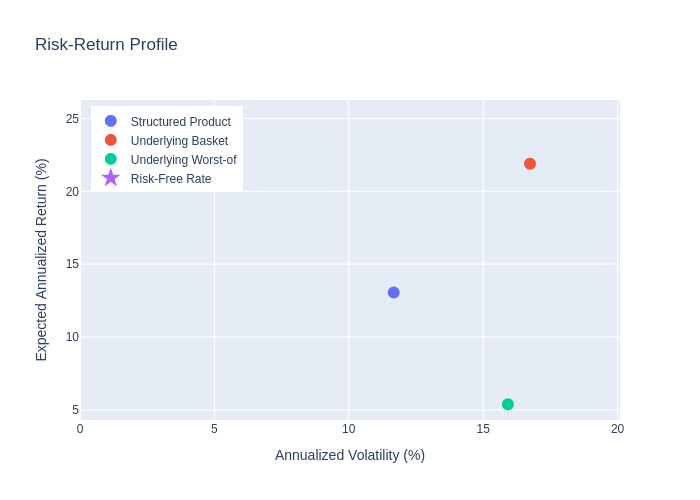
Chart from a real Speval analysis report.
Example report from the full analyzer
10.75%
Annual coupon
Example note
60%
Knock-in barrier
Continuous
17.80%
Probability of loss
Simulated
13.8 mo
Expected holding period
Not 24 months
Before you run a full simulation, it helps to do the arithmetic: how much coupon does the note pay, where is the barrier, and how far can the underlying fall before the payoff changes? Those numbers do not require a model, and they catch a surprising number of bad term sheets.
The calculator below handles coupon income, barrier distance, and autocall timing. When you need autocall probability, loss probability, or a return distribution, upload the term sheet to the full analyzer.
What the calculator does
The quick calculator answers four questions:
- Annual coupon income. Notional multiplied by the annual coupon rate.
- Total coupon to maturity. Annual coupon income multiplied by the term.
- Coupon if autocalled. Annual coupon income multiplied by the expected autocall month divided by twelve.
- Barrier level and distance. The barrier price, and how far the current price is above it.
It is deterministic arithmetic. It does not model volatility, correlation, path dependency, or the probability of an autocall.
Coupon math
The basic formula is:
Annual coupon income = Notional × Annual coupon rate
For a 100,000 notional and a 10.75% coupon, the annual income is 10,750. Over a two-year term, the total coupon is 21,500, assuming the note survives and pays every coupon.
If the note can autocall after six months, the expected coupon is closer to 5,375, not 21,500. That is why the stated term and the expected holding period are different numbers.
Barrier math
The barrier level is:
Barrier level = Initial price × Barrier percentage
For an initial price of 100 and a 60% barrier, the barrier is 60. If the current price is 100, the distance to the barrier is 40%. If the current price is 90, the distance is 33.3%.
The observation style matters. A continuous barrier can be triggered intraday; a closing-price barrier is tested only at the close; a maturity-only barrier is tested once. The same level produces different breach probabilities.
Autocall timing
The coupon earned before an autocall is:
Coupon at autocall = Annual coupon income × (Autocall month ÷ 12)
If the note autocalls at month six, the investor earns half the annual coupon. If it autocalls at month twelve, the investor earns the full year. The annualized return depends on when the call happens, not just whether it happens.
What the calculator cannot tell you
The calculator cannot tell you:
- How likely the note is to autocall.
- How likely the barrier is to be breached.
- What the loss looks like if the barrier is breached.
- How the note compares with the underlying or cash.
- What the issuer's credit risk is worth.
- Whether the coupon compensates for the risk.
Those require a Monte Carlo simulation of the underlying and the note's payoff rules. That is what the full analyzer does.
From calculator to full analysis
A sensible workflow is:
- Use the calculator to check the coupon, barrier, and autocall arithmetic.
- Read the term sheet to confirm the observation style, barriers, and settlement rules.
- Upload the term sheet to the free evaluator for the full distribution.
- Compare the expected return, probability of loss, autocall probability, and 99% VaR with the alternatives.
- Document the scenario that would make the recommendation wrong.
The calculator is a first pass, not a substitute for the analysis.
Related analysis
- Structured notes analysis tool for the full workflow.
- ELN analysis tool for equity-linked notes.
- Autocallable notes analysis tool for autocall structures.
- Reverse convertible analysis tool for barrier reverse convertibles.
The calculator is provided for illustration only and is not investment advice.
Quick calculator
Structured product calculator
Estimate coupon income, the barrier level, and the distance to the barrier. This is arithmetic, not a simulation — use the full analyzer for autocall probability and a return distribution.
Annual coupon income
—
Total coupon to maturity
—
Coupon if autocalled
—
Barrier level
—
Distance to barrier
—
Coupon yield on notional
—
Quick arithmetic only. Ignores autocall probability, volatility, correlation, issuer fees, and taxes. Not investment advice.
Example report from the full analyzer
UBS 10.75% p.a. CHF Autocall Barrier Reverse Convertible
This is a full report generated by Speval from a real term sheet. The same analysis is available for your product — upload the document and get the report in minutes.
Frequently asked questions
Is this a structured product pricing calculator?
The quick calculator handles coupon income, barrier distance, and simple break-even math. For fair value, autocall probability, and a full return distribution, upload the term sheet to the Speval analyzer.
How do I calculate structured product coupon income?
Multiply the notional by the annual coupon rate by the number of years the note is expected to be outstanding. If the note can autocall early, use the expected holding period rather than the stated maturity.
How do I calculate barrier distance?
Divide the barrier level by the current underlying price and subtract one. For a 60% barrier and a price at 100% of initial, the underlying can fall 40% before the barrier is reached.
Can I use this calculator for ELNs and autocallables?
Yes for the quick coupon and barrier math. For ELN participation, caps, and autocall probabilities, use the ELN or autocallable analysis pages and the full analyzer.
Why is the calculator's result different from the full report?
The calculator is deterministic arithmetic. The report simulates thousands of paths, applies the note's actual payoff rules, and accounts for autocalls, barriers, volatility, and correlations.
Does the calculator store my inputs?
No. The quick calculator runs in your browser. Uploaded term sheets are handled according to the privacy policy.
Related analysis tools
Further reading
Run this analysis on your own term sheet
Upload a PDF, Excel, or Word term sheet. Speval extracts the terms, runs 10,000 Monte Carlo paths, and returns autocall probability, probability of loss, expected return, and scenario charts.