Market-linked notes · protection & participation
Market-Linked Notes Analysis Tool
Market-linked notes trade market participation for protection, income, or a cap. The analysis has to price that trade, not just quote the participation rate.
No login required · Independent, issuer-neutral analysis
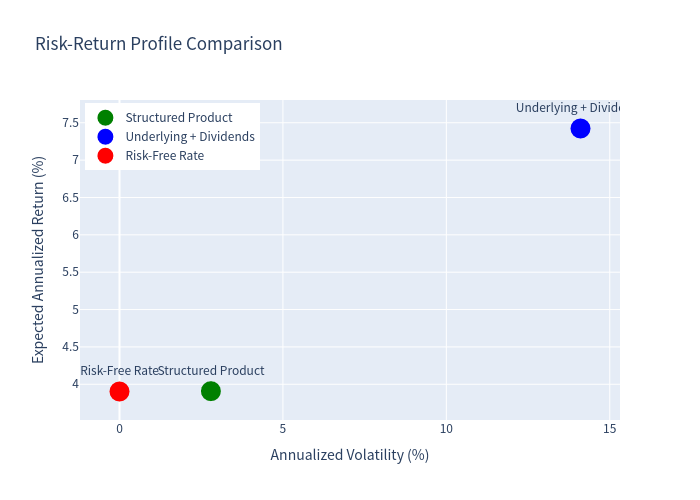
Chart from a real Speval analysis report.
Example market-linked note analysis
100%
Principal protection
At maturity
3.91%
Expected annualized return
5-year term
0.00%
Probability of loss
Nominal principal
33.25%
Total return cap
Fixed upside
A market-linked note ties the return of a bond to a market index or asset. The investor usually gets some combination of principal protection, participation in the index, a cap, and a term. The structure is sold as a way to participate in markets with less downside; the analysis is about what that participation actually costs.
A market-linked notes analysis tool should compare the protection, participation, cap, and term against the index's distribution, and show the opportunity cost of the protection.
What is a market-linked note?
A market-linked note typically has:
- A principal protection level. Often 100%, sometimes less.
- A participation rate. The percentage of the index's positive return the investor receives.
- A cap. The maximum return, either as a total return or an annualized return.
- A term. Often three to seven years.
- An issuer. The note is an unsecured obligation, not a deposit (unless it is a market-linked CD).
The return can be based on a price index, a total-return index, a volatility-controlled index, or a custom index. The index definition matters as much as the participation rate.
Protection, participation, and caps
The three features are linked:
- Higher protection usually means lower participation or a tighter cap.
- Higher participation usually means less protection or a longer term.
- A cap limits the upside in strong markets, which is where the opportunity cost is largest.
A note with 100% protection and 100% participation sounds generous. It is usually funded by a long term, no income, and a cap that clips the upside. The analysis should show the cap's effect on the distribution.
Worked example: Morgan Stanley Jump Notes
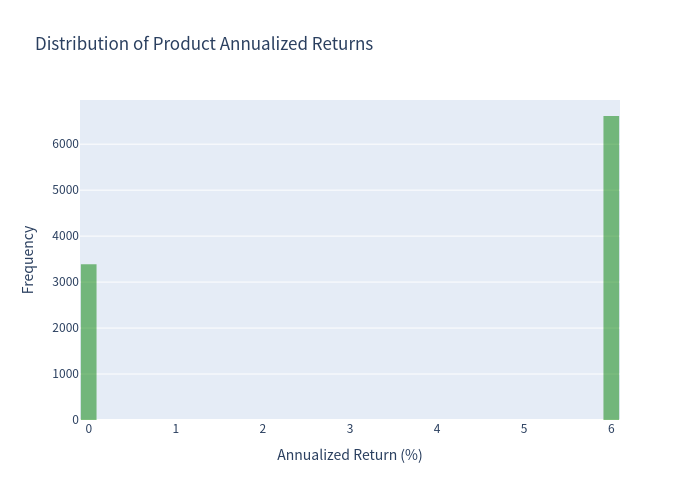
Speval's example report analyzes Morgan Stanley Jump Notes due December 2030, linked to the BlackRock Adaptive U.S. Equity 5% Index. The note offers 100% principal protection at maturity, a fixed upside payment of 33.25% of principal if the index is at or above its initial level, and no coupons. If the index is below its initial level, the investor receives principal back.
The simulation produced:
- 3.91% expected annualized return — versus 7.42% for the index with dividends.
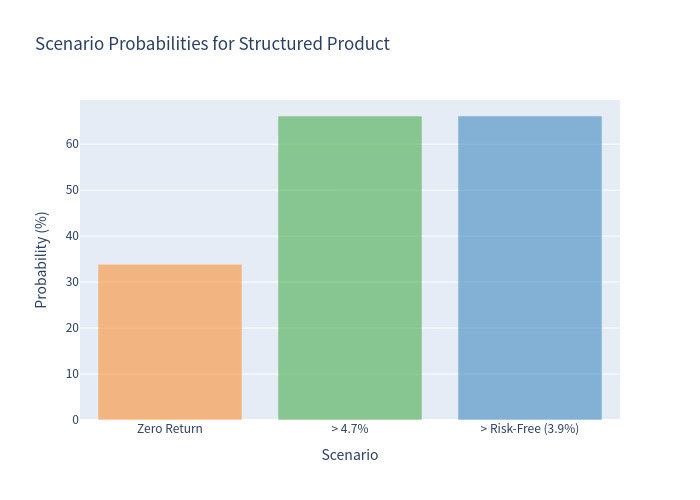
- 0.00% probability of a negative return — the principal floor holds in the simulation.
- 2.80% annualized volatility — versus 14.11% for the index.
- 66.13% probability of receiving the upside payment — about two-thirds of paths.
- 33.25% maximum total return — the cap.
The note eliminates nominal downside and reduces volatility dramatically, but the expected return is roughly half the index's. The investor is paying for protection with upside.
Market-linked note vs PPN vs ELN
- Market-linked note. A broad label for notes linked to a market index, often with protection and participation.
- PPN. A note with a stated principal protection level; the participation and cap determine the upside.
- ELN. A note linked to equities; may be protected, partially protected, or unprotected.
The labels overlap. The analysis should follow the payoff and the index definition, not the category.
What to check in a market-linked note term sheet
- Index definition. Price return vs total return; volatility-controlled vs custom; how the index is calculated.
- Protection level. 100%, 95%, or 90%; measured at maturity only?
- Participation rate and cap. Is the cap on the total return or the annual return? Is participation on the index or a multiple?
- Term. Longer terms increase the opportunity cost and the credit exposure.
- Issuer credit. The protection is only as good as the issuer.
- Liquidity. Secondary market availability and spreads.
- Fees. Embedded fees reduce participation and may not be disclosed as a line item.
Opportunity cost is the main risk
For a fully protected note, the main risk is not losing principal. It is earning less than the alternatives:
- Cash. If the note's expected return is below the risk-free rate, the protection is expensive.
- The index. If the index rallies strongly, the cap limits the gain.
- Inflation. Nominal principal protection may not preserve purchasing power.
The analysis should show the expected return versus cash, the index, and a protected alternative, not just the probability of loss.
Related analysis
- ELN analysis tool for equity-linked notes.
- Principal protected note analysis tool for 100% protection structures.
- Structured notes analysis tool for the broader category.
- Structured product calculator for quick coupon and barrier math.
Figures in this article come from a Speval example report and are simulated, not investment advice.
Example market-linked note analysis
Morgan Stanley Jump Notes on the BlackRock Adaptive U.S. Equity 5% Index
This is a full report generated by Speval from a real term sheet. The same analysis is available for your product — upload the document and get the report in minutes.
Frequently asked questions
What is a market-linked note?
A market-linked note is a structured note whose return is tied to a market index or asset. It usually combines a protected or partly protected bond with an option that provides participation, a cap, or a fixed upside payment.
Is a market-linked note the same as a structured note?
Market-linked notes are a subset of structured notes. The term is often used for principal-protected or participation-style notes linked to an index, including market-linked CDs.
How do you analyze a market-linked note?
Compare the protection level, participation rate, cap, term, and issuer credit spread against the underlying's return distribution. The key outputs are expected return, probability of loss, probability of receiving the upside payment, and sensitivity to volatility and rates.
Why does a protected note still have opportunity cost?
The protection is funded from the note's economics. The investor gives up some combination of income, upside, or liquidity. If the underlying rallies strongly, the protected note will underperform a direct investment.
Can a market-linked note lose money?
A fully principal-protected note can still lose in real terms to inflation and opportunity cost, and it carries issuer credit risk. Partially protected or unprotected market-linked notes can lose principal if the underlying falls below the protection level.
What is a market-linked CD?
A market-linked CD is a bank deposit whose return is linked to a market index. It typically offers FDIC insurance up to applicable limits, but the market-linked return may be capped or participation-limited.
Related analysis tools
Further reading
Run this analysis on your own term sheet
Upload a PDF, Excel, or Word term sheet. Speval extracts the terms, runs 10,000 Monte Carlo paths, and returns autocall probability, probability of loss, expected return, and scenario charts.