Buffered notes · partial protection
Buffered Notes Analysis Tool
A buffer protects the first slice of a decline and passes through the rest. The size of that slice, and where the knock-in sits, determines whether the note is genuinely defensive or just less aggressive.
No login required · Independent, issuer-neutral analysis
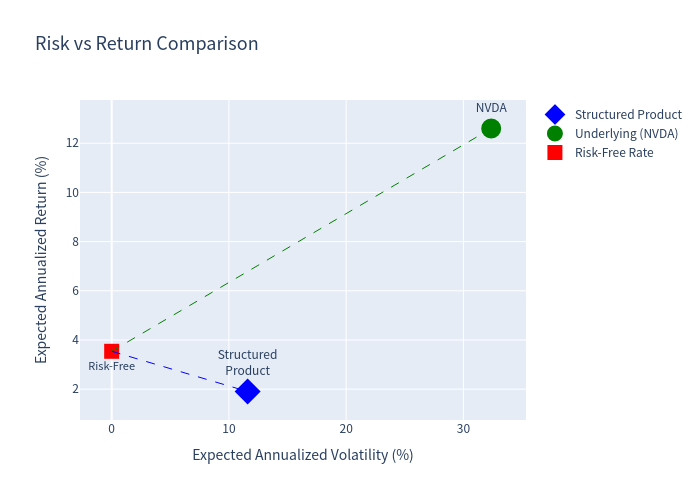
Chart from a real Speval analysis report.
Example buffered note analysis
67%
Knock-in barrier
Continuous monitoring
13.08%
Probability of loss
vs. 25.03% NVDA
74.97%
Autocall probability
Quarterly
1.90%
Expected annualized return
Capped upside
A buffered note absorbs the first part of a decline and passes the rest through. The buffer can make a note look defensive, especially when the headline says "10% buffer" or "20% protection." But the buffer is only one part of the payoff. The strike, the knock-in level, the observation style, and the upside cap determine whether the note is genuinely defensive or just less aggressive.
A buffered notes analysis tool should show the whole loss distribution: how often the buffer holds, what happens when it does not, and what the investor gives up for the protection.
What is a buffered note?
A buffered note typically has:
- A buffer. The first slice of a decline that the issuer absorbs, for example the first 10% or 15%.
- A strike or reference level. The level from which the buffer is measured.
- A knock-in barrier. A level that, if breached, can change the payoff.
- Upside participation or a cap. The return the investor receives if the underlying rises.
- A term and observation style. Buffers are often measured at maturity, while knock-ins may be continuous.
The buffer is not the same as principal protection. A 15% buffer means the investor can lose everything beyond the first 15% of a decline.
Buffer, strike, and knock-in are different things
These terms are often used interchangeably in marketing, but they are not the same:
| Feature | What it does |
|---|---|
| Buffer | Absorbs a fixed percentage of loss before the investor participates in the decline |
| Strike | Sets the reference price for the maturity payoff |
| Knock-in | A level that, once breached, can activate a different payoff formula |
A note can have a buffer at maturity and a knock-in that is observed continuously. The buffer may never be reached if the knock-in already changed the payoff. The analysis has to apply both rules in the right order.
Worked example: NVDA autocallable with a 67% knock-in and 90% strike
Speval's example report analyzes an NVDA-linked autocallable certificate with a 67% knock-in barrier, a 90% strike, quarterly observations, and a 2.5% quarterly coupon (10% per annum). The note can autocall if NVDA is at or above its initial level on an observation date.
The simulation produced:
- 1.90% expected annualized return — versus 12.60% for NVDA.
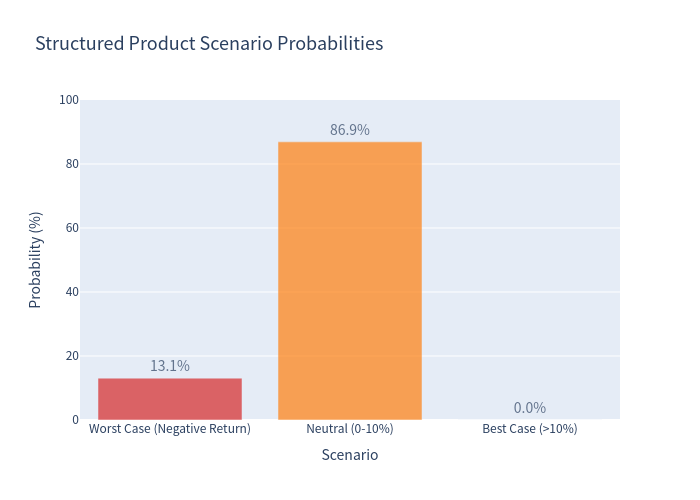
- 13.08% probability of loss — versus 25.03% for the underlying.
- 74.97% autocall probability — the note is usually called early.
- 11.59% expected volatility — versus 32.37% for NVDA.
- -47.23% 99% VaR — the tail is still severe.
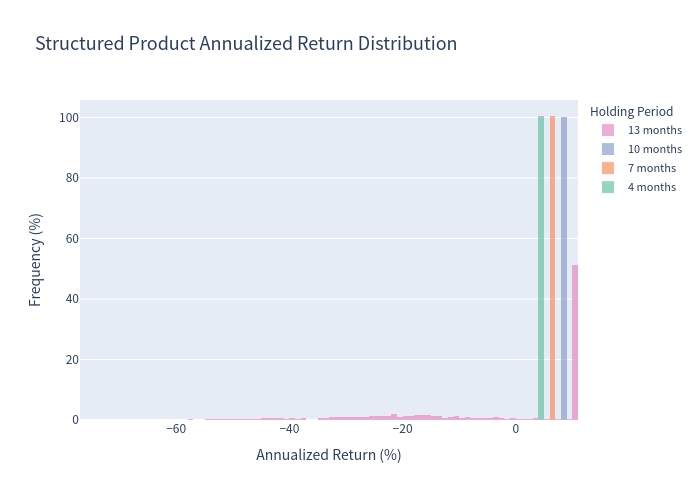
The buffer reduces the probability of a small loss and lowers volatility, but it does not eliminate the tail. The 99% VaR is almost as large as the underlying's because the paths that breach the knock-in can lose most of the principal.
How the buffer changes the loss distribution
A buffer does three things to the distribution:
- It cuts the frequency of small losses. If the underlying falls by less than the buffer, the investor may lose nothing at maturity.
- It does not cut the frequency of large losses. Once the buffer is exhausted, the investor takes the decline beyond it.
- It changes the shape of the tail. The loss distribution can become more bimodal: many small gains or flat outcomes, and a cluster of large losses.
That is why probability of loss alone is not enough. A buffered note can have a lower probability of loss than the underlying and a worse 99% VaR.
Buffered note vs PPN
- Buffered note. Protects a slice of the decline; the investor keeps more upside but is exposed beyond the buffer.
- PPN. Protects 100% (or a high percentage) of principal; the investor gives up more upside, income, or liquidity.
A buffered note is usually more aggressive than a PPN and less aggressive than the underlying. The right choice depends on the client's loss tolerance and the note's participation.
What to check in a buffered note term sheet
- Buffer size and measurement. Is the buffer measured at maturity or continuously? Is it based on the initial price or the strike?
- Knock-in level and observation style. Continuous barriers trigger more often.
- Strike. A strike below the initial price provides more room before losses begin.
- Upside participation and cap. How much upside is available, and at what point does it stop?
- Autocall feature. Early redemption can shorten the holding period and change the realized return.
- Issuer credit. The buffer is only as good as the issuer.
Related analysis
- Principal protected note analysis tool for full protection.
- Autocallable notes analysis tool for autocall features.
- Structured notes analysis tool for the broader category.
- Structured product calculator for quick coupon and barrier math.
Figures in this article come from a Speval example report and are simulated, not investment advice.
Example buffered note analysis
NVDA Autocallable Certificate with 67% knock-in and 90% strike
This is a full report generated by Speval from a real term sheet. The same analysis is available for your product — upload the document and get the report in minutes.
Frequently asked questions
What is a buffered note?
A buffered note absorbs the first part of a decline, for example the first 10% or 20%, and passes losses beyond the buffer through to the investor. It is a partial-protection structure, not a principal-protected one.
How does a buffer differ from a knock-in barrier?
A buffer is the slice of loss the issuer absorbs. A knock-in barrier is a level that, once breached, can change the payoff entirely. Some notes use both: the buffer applies at maturity, while the knock-in determines whether the downside formula is activated.
How do you analyze a buffered note?
Model the buffer, the knock-in level, the observation style, and the upside participation together. The key outputs are probability of loss, loss severity beyond the buffer, probability of a barrier event, and expected return versus the underlying.
Is a buffered note safer than the underlying?
It usually has a lower probability of a small loss and lower volatility, but it can still lose substantially beyond the buffer. The trade-off is capped or reduced upside. The analysis should show both sides.
What is a buffered autocallable?
A buffered autocallable combines a buffer or knock-in protection with early redemption. The autocall can shorten the holding period, while the buffer determines what happens if the note is not called and the underlying falls.
Why does the strike matter in a buffered note?
The strike sets the reference level for the maturity payoff. A lower strike provides more room before losses begin; a strike near the initial price means the buffer is doing most of the work.
Related analysis tools
Further reading
Run this analysis on your own term sheet
Upload a PDF, Excel, or Word term sheet. Speval extracts the terms, runs 10,000 Monte Carlo paths, and returns autocall probability, probability of loss, expected return, and scenario charts.