How Do Dual Directional Buffered PLUS Products Work?
How Do Dual Directional Buffered PLUS Products Work?
Dual Directional Buffered PLUS products are a unique type of structured product that offers upside participation while also having a buffer against moderate downside. Here's how they work, with a real example.
The Core Structure
A Dual Directional Buffered PLUS (sometimes called a "Dual Directional Buffered Participation Note"):
The "dual directional" part means the product participates in both directions — upside participation in rising markets, but also downside participation (after the buffer) in falling markets.
- Participates in upside at a specified participation rate (e.g., 120% of index gains)
- Buffers against declines — losses only start after the buffer is exhausted (e.g., first 15% decline is absorbed)
- Zero coupon — all return comes from market performance
Real Example: Worst-of INDU, NDX, RTY
We analyzed a Dual Directional Buffered PLUS linked to a worst-of basket of three indices: the Dow Jones Industrial Average (INDU), Nasdaq-100 (NDX), and Russell 2000 (RTY).
The product has zero coupon — all return depends on how the worst-performing index performs. The expected annualized return was 6.81%, based on 50,000 simulated market paths.
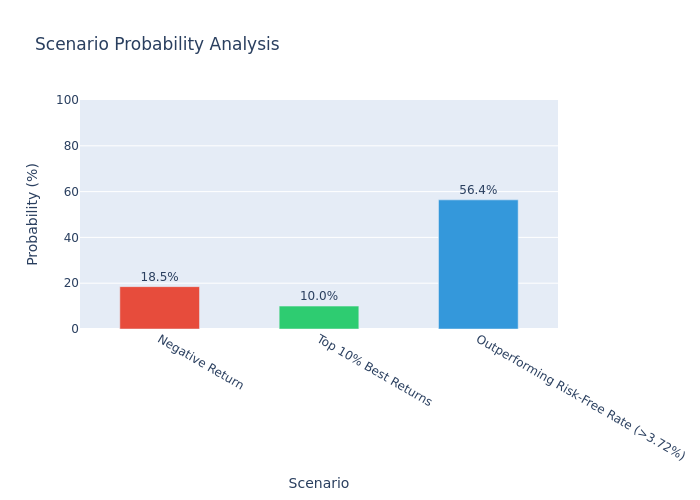
Understanding the Risk Profile
Because this is a worst-of structure, the product tracks the worst-performing index at maturity. This creates a concentrated risk:
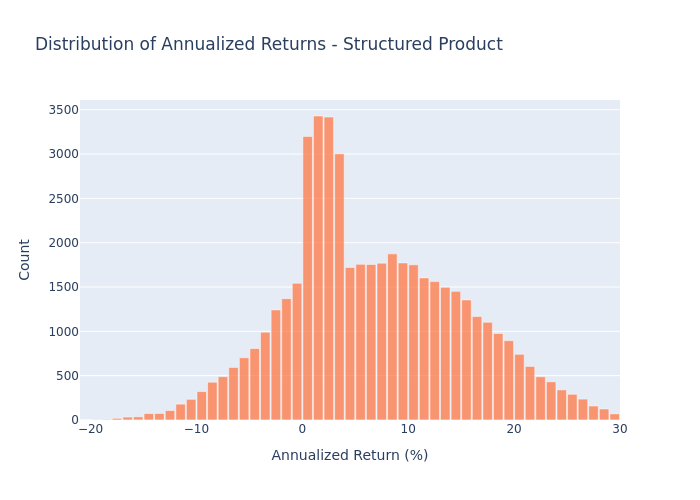
How Return Scenarios Play Out
Strong bull market (all indices up): You receive your upside participation — potentially significant returns if the participation rate is above 100%.
Moderate decline (indices down <15%): The buffer absorbs the loss. You get your principal back in full.
Sharp decline (indices down >15%): You participate in the decline beyond the buffer. For example, if the worst index is down 25%, you might lose approximately 10% (25% decline minus 15% buffer = 10% loss).
Mixed market: Since this is worst-of, if one index is up 20% but another is down 10%, the product tracks the down-10% index — and the buffer absorbs that loss.
Dual Directional vs. Regular Buffered PLUS
The key difference:
Key Takeaway
Dual Directional Buffered PLUS products work well when you expect moderate to strong market performance but want a cushion against small declines. The worst-of structure adds significant concentration risk — if just one of three indices drops sharply, your return suffers even if the others perform well.
Analyze your own Dual Directional Buffered PLUS with Token Engine's SP Evaluator. Upload the term sheet and get a full Monte Carlo simulation of expected returns and loss probabilities.