Autocallables · Phoenix & memory structures
Autocallable Notes Analysis Tool
Autocallables are sold on the coupon and the early-redemption story. The risk lives in the paths that never autocall. Speval shows both: how often the note is called, when, and what happens when it is not.
No login required · Independent, issuer-neutral analysis
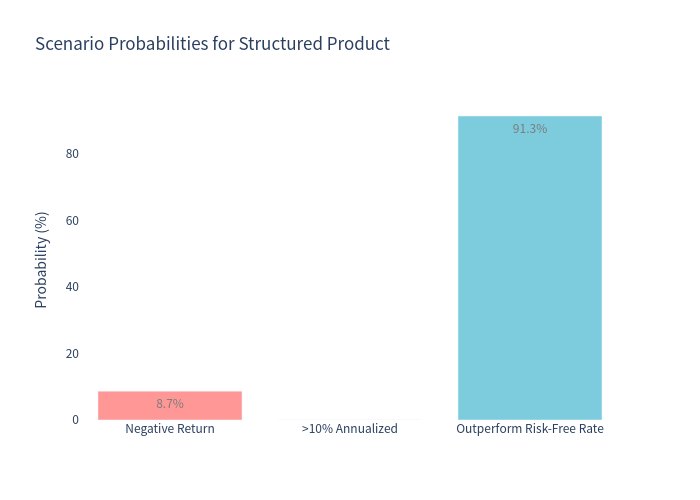
Chart from a real Speval analysis report.
Example autocallable note analysis
72.12%
Autocall probability
Early redemption
3.44%
Expected annualized return
10% max coupon
8.66%
Probability of loss
67% knock-in
6.2 mo
Expected holding period
Quarterly calls
An autocallable note is a structured note that can redeem early. On scheduled observation dates, if the underlying is at or above a trigger level, the note is called: the investor gets principal back plus the coupon due. If it is never called, the note runs to maturity and may expose the investor to a knock-in loss.
That single feature creates four very different outcomes, and the headline coupon describes none of them. An autocallable notes analysis tool should show how often each outcome happens, when, and what it pays.
The same framework applies whether the term sheet says autocallable notes, autocall notes, or Phoenix notes. The label changes; the path-by-path analysis does not.
What is an autocallable note?
A typical autocallable has:
- Observation dates. Quarterly, semi-annual, or monthly dates on which the autocall and coupon conditions are tested.
- An autocall trigger. Usually 100% of the initial underlying price. If the underlying is at or above it on an observation date, the note redeems.
- A coupon condition. A coupon may be paid only if the underlying is above a coupon barrier, which can be lower than the autocall trigger.
- A knock-in barrier. If the underlying falls below this level, the maturity payoff can be reduced.
- A maturity payoff. If the note is not called and no knock-in occurs, principal is typically returned. If a knock-in occurs, the investor may take the underlying's downside.
Phoenix, memory, and step-down variants change the coupon and trigger rules, but the core question is the same: what happens on the paths that do not autocall?
The four paths an autocallable can take
- Called early. The underlying reaches the trigger on an observation date. The investor receives principal plus accrued coupons, and the note ends.
- Survives to maturity without a knock-in. Principal is returned, plus any coupons paid along the way.
- Knock-in occurs but the underlying recovers. The maturity payoff may still return principal, depending on the terms.
- Knock-in occurs and the underlying finishes below the strike. The investor takes a loss, potentially a large one.
The coupon is compensation for paths 3 and 4, not a free yield. The analysis should show the probability and severity of each path.
Worked example: an NVDA autocallable certificate
Speval's example report for an NVDA-linked autocallable certificate is a useful case because the terms are simple enough to follow. The note has a one-year term, quarterly observations, a 100% autocall trigger, a 67% knock-in barrier observed only on the final valuation date, a 50% coupon barrier, and a maximum coupon of 10% per annum (2.5% per quarter). Upside is capped at principal.
The simulation produced:
- 72.12% autocall probability — the note is called in nearly three out of four paths.
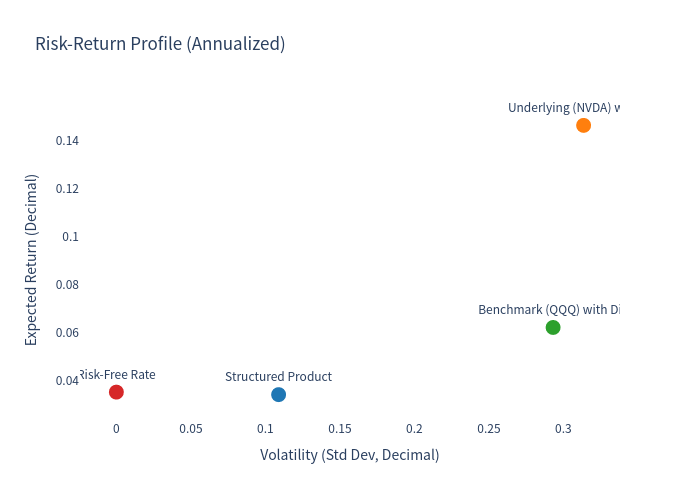
- 3.44% expected annualized return — versus a 10% maximum coupon.
- 8.66% probability of loss — versus 23.69% for NVDA.
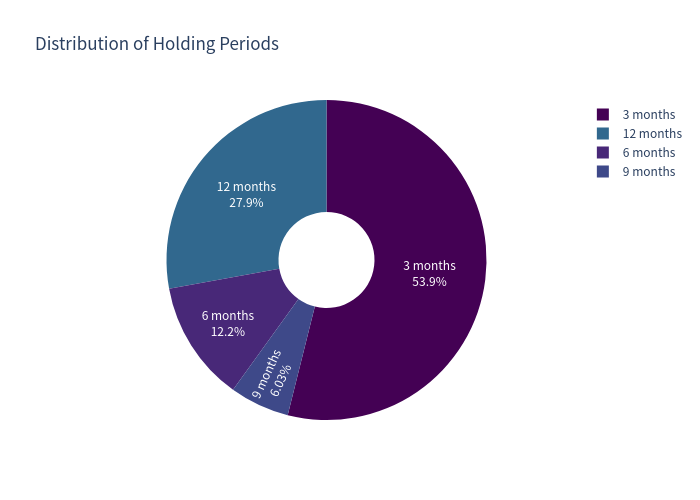
- 6.2 months expected holding period — not 12 months.
- 2.04 coupons received on average.
The early-redemption timing matters. In the report, the probability of being called at the first observation is much higher than at later ones. That is why the expected holding period is roughly half the stated term, and why the annualized return is far below the coupon.
Why the coupon is not the expected return
A 10% coupon sounds like a 10% return. It is not, for three reasons:
- The note may be called early. If the average holding period is six months, the investor earns roughly half the annual coupon, and the capital is then reinvested at whatever rates are available.
- The coupon may be conditional. If the underlying falls below the coupon barrier, the coupon can be skipped. Memory features can recover skipped coupons, but not always.
- The loss paths are expensive. The paths where the note is not called are often the paths where the underlying has fallen. That is exactly when the knock-in loss is largest.
The expected return combines all three effects. In the NVDA example, the result is 3.44% annualized, not 10%.
How to compare two autocallables
Compare them on the same axes:
| Comparison | Why it matters |
|---|---|
| Expected annualized return | Puts different coupons and holding periods on a common basis |
| Probability of loss | Shows how often the coupon is not enough to offset the downside |
| Autocall probability and timing | Determines how long the capital is actually at work |
| Knock-in level and observation style | Continuous barriers trigger more often than maturity-only barriers |
| Coupon barrier and memory feature | Determines whether coupons are actually paid |
| Worst-of vs single-name | A basket can increase the coupon and the tail risk |
| Issuer and currency | Credit risk and FX risk are not in the coupon |
A higher coupon is not automatically better. It is usually compensation for a lower trigger, a worse barrier, a longer expected holding period, or a riskier underlying.
Phoenix, memory, and step-down structures
- Phoenix. Adds conditional coupons and often a memory feature. If a coupon is missed, it can be recovered on a later date if conditions are met.
- Memory. The coupon-recovery feature itself. It increases the value of the coupon stream but can make the note harder to compare with a plain autocallable.
- Step-down. The autocall trigger declines over time, making early redemption more likely in later periods.
- Snowball. Coupons can accrue and compound under specified conditions.
The simulation should apply the exact observation and memory rules, not an approximation.
How Speval models autocall probability
Speval generates 10,000 paths for the underlying, applies the autocall, coupon, and knock-in rules on every observation date, and counts the paths that redeem early. The same paths produce the expected return, loss probability, holding-period distribution, and scenario charts. Because every metric comes from the same simulation, the numbers are internally consistent.
Related analysis
- Reverse convertible analysis tool for barrier reverse convertibles.
- Worst-of notes analysis tool for basket-linked autocallables.
- Structured notes analysis tool for the broader category.
- Structured product calculator for quick coupon and barrier math.
Figures in this article come from a Speval example report and are simulated, not investment advice.
Example autocallable note analysis
NVDA Autocallable Certificate (SGD quanto)
This is a full report generated by Speval from a real term sheet. The same analysis is available for your product — upload the document and get the report in minutes.
Frequently asked questions
What is an autocallable note?
An autocallable note is a structured note that redeems early if the underlying is at or above a trigger level on a scheduled observation date. If it is not called, it continues to maturity and may expose the investor to a knock-in loss.
How is autocall probability calculated?
Autocall probability is the share of simulated price paths in which the underlying crosses the autocall trigger on at least one observation date. Speval computes it from the same 10,000 paths used for the payoff analysis, so it is consistent with expected return and loss figures.
What is a good autocall probability?
There is no universal threshold. A high autocall probability shortens the holding period and caps total coupon income; a low one leaves more exposure to the maturity payoff and knock-in risk. The right level depends on the coupon, the barrier, and the investor's objective.
What is the difference between Phoenix and autocallable notes?
A Phoenix structure typically adds conditional coupons and a memory feature: missed coupons can be recovered later if conditions are met. A plain autocallable pays coupons on observation dates and calls the note when the trigger is reached. Both are modelled path by path.
Why does expected holding period matter?
Annualized return figures can look attractive when a note is likely to be called early. The expected holding period tells you how long the capital is actually exposed, and what the annualized number is being annualized over.
Can an autocallable note lose principal?
Yes. If the note is not called and the underlying breaches the knock-in barrier, the maturity payoff can be reduced, sometimes by most of the principal. The analysis should show the probability and severity of that outcome, not only the coupon.
Related analysis tools
Further reading
Run this analysis on your own term sheet
Upload a PDF, Excel, or Word term sheet. Speval extracts the terms, runs 10,000 Monte Carlo paths, and returns autocall probability, probability of loss, expected return, and scenario charts.