
tokenengine.ai
Structured Product Evaluator
info@tokenengine.ai
Structured Product Analysis Report
Morgan Stanley Jump Notes due December 23, 2030
This report analyzes the risk-return profile of the Morgan Stanley Jump Notes based on the BlackRock Adaptive U.S. Equity 5% Index. The product offers principal protection with capped upside participation over a 5-year term.
Headline Simulation Results (10,000 Monte Carlo simulations):
Key Details
- Issuer: Morgan Stanley Finance LLC (guaranteed by Morgan Stanley)
- Underlying Index: BlackRock Adaptive U.S. Equity 5% Index
- Term: 5 years (December 2025 to December 2030)
- Principal Protection: Yes (100% of principal at maturity)
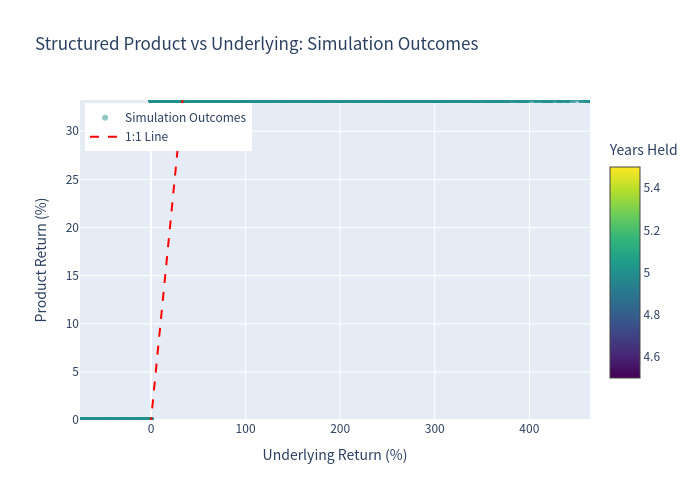
- Upside Potential: Capped at 33.25% total return (approximately 5.91% annualized)
- Coupons: None
How It Works
At maturity, if the index level is at or above its initial level, investors receive their principal plus a fixed upside payment (33.25% of principal). If the index is below its initial level, investors receive only their principal back. The maximum possible total return is capped at 33.25% regardless of how high the index rises.
| Metric | Structured Product | Underlying Index + Dividends |
|---|---|---|
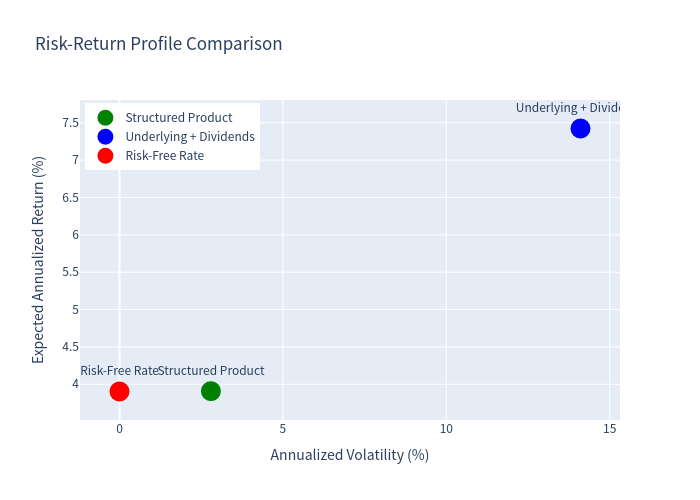
| Expected Annualized Return | 3.91% | 7.42% |
| Annualized Volatility | 2.80% | 14.11% |
| Probability of Loss | 0.00% | 30.96% |
| 99% VaR (1-year) | 0.00% | -23.21% |
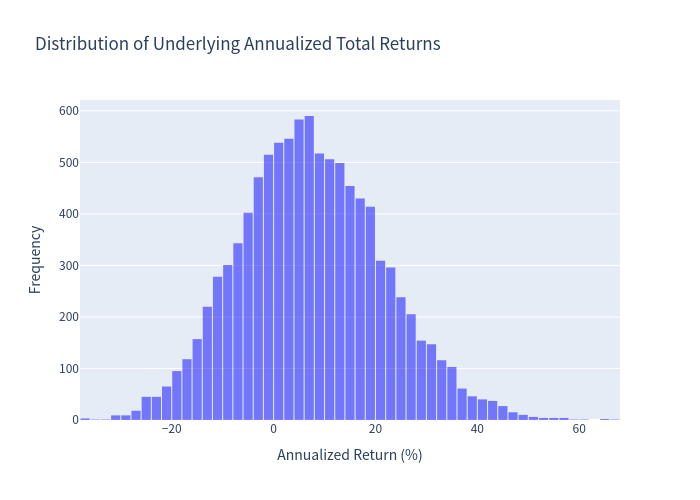
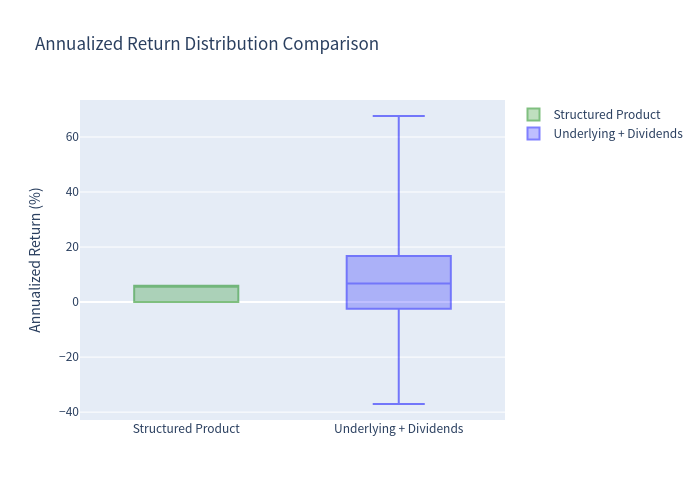
| Maximum Simulated Return | 5.91% | 67.62% |
| Minimum Simulated Return | 0.00% | -37.04% |
Return Distribution:
- The structured product provides a floor of 0% total return (principal protection) and a cap of 33.25% total return.
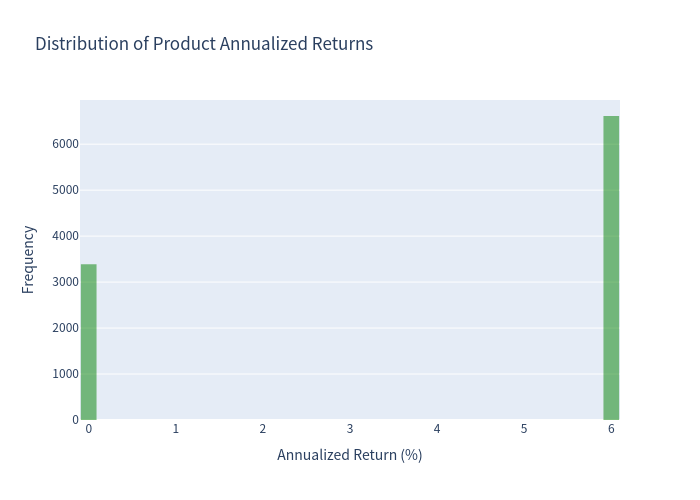
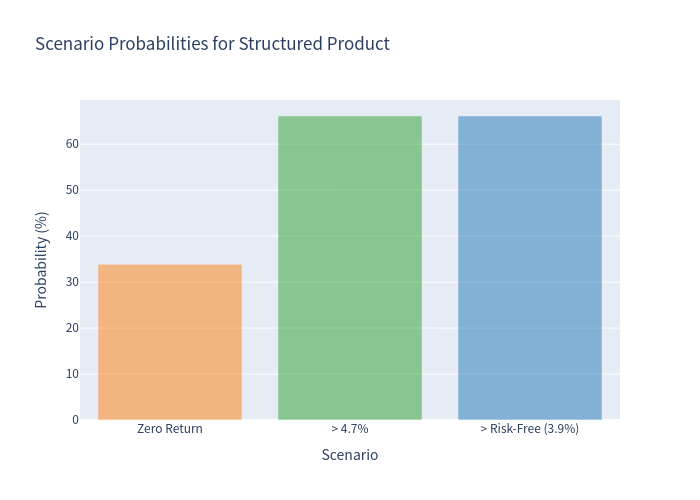
- 66.1% of simulations resulted in the upside payment being received.
- 33.9% of simulations resulted in only principal repayment (0% return).
Risk Characteristics:
- The product significantly reduces volatility compared to the underlying index (2.8% vs 14.1%).
- The product eliminates downside risk (0% probability of loss vs 31.0% for the index).
- The trade-off is capped upside potential, limiting participation in strong market rallies.
1. Simulation Outcomes Scatter Plot
Each point represents one simulation outcome. The red dashed line shows the 1:1 relationship for reference.
2. Return Distribution Histograms
Distribution of annualized total returns for the underlying index (including dividends).
Distribution of annualized returns for the structured product. Note the concentration at 0% and around 5.91%.
3. Scenario Probabilities
Probability of key scenarios: zero return, high return, and outperforming the risk-free rate.
4. Risk-Return Profile
Comparison of expected return vs volatility for the product, underlying index, and risk-free rate.
5. Return Distribution Box Plot
Box plot comparison of annualized return distributions.
Potential Advantages:
- Principal Protection: Investors receive at least their initial investment back at maturity.
- Reduced Volatility: Significant reduction in return volatility compared to direct equity exposure.
- Defined Risk: Maximum loss is limited to opportunity cost (foregone interest).
- Positive Expected Return: The product offers a positive expected return with no downside risk.
Limitations:
- Capped Upside: Participation in market gains is limited to the fixed upside payment (33.25% total), regardless of how high the index rises.
- Opportunity Cost: In strong bull markets, the product will underperform direct index investment.
- No Income: The product pays no coupons or interest during the holding period.
- Credit Risk: Payments are subject to the creditworthiness of Morgan Stanley.
- Inflation Risk: The fixed principal repayment may not keep pace with inflation over 5 years.
- Simulation Model: Monte Carlo simulation using GJR-GARCH(1,1) with Student's t distribution fitted to 20 years of historical index data.
- Dividend Yield: 1.07% annual dividend yield added to underlying index returns.
- Risk-Free Rate: 3.90% based on 1-year average U.S. Treasury rate.
- Simulations: 10,000 simulated paths over 5 years.
- Underlying Proxy: S&P 500 index used as proxy for BlackRock Adaptive U.S. Equity 5% Index.
The Morgan Stanley Jump Notes offer a principal-protected investment with limited upside participation. The product may be suitable for risk-averse investors seeking equity exposure with downside protection, but investors should be aware of the capped upside potential and consider alternative investments that may offer better risk-adjusted returns in certain market environments.
This analysis is for informational purposes only and does not constitute investment advice. Investors should consult with financial advisors before making investment decisions.