
7.40% p.a. Multi Barrier Reverse Convertible on Alcon, Nestlé, Roche (Callable)
Headline Simulation Results
| Headline metric | Value |
|---|---|
| Expected annualized return | 5.08% |
| Probability of a negative return | 10.27% |
| 99% confidence 1-year VaR | -20.56% |
| Expected holding period | 1.63 years (~19.6 months) |
| Expected total return over the realized holding period | 7.94% |
| Median annualized return (typical outcome) | 7.14% |
Over 10,000 simulated paths the note produced a typical (median) annualized return of about 7.1%, i.e. close to the headline coupon. That figure is pulled down to an expected annualized return of 5.08% by a ~10% tail of paths in which the barrier is breached and the investor absorbs the full downside of the worst-performing share.
What This Product Is (Plain Language)
This is a yield-enhancement note (a "reverse convertible") linked to the worst-performing of Alcon, Nestlé and Roche, running for two years from 13/10/2026 to 13/10/2028.
- Coupon: a fixed 7.40% p.a. (CHF 18.50 per CHF 1,000), paid quarterly in eight instalments, regardless of how the shares perform.
- Capital protection (conditional): at maturity the investor receives the full CHF 1,000 back — unless the worst of the three shares has traded at or below 59% of its starting level at any moment during the two years (a barrier event).
- If the barrier is breached and the worst share finishes below its starting level, the investor instead receives that worst-performing share, worth its final value — i.e. the full downside is taken. If the worst share recovers to at least its starting level by maturity, par is returned even after a breach.
- Issuer call: the issuer may call the note early on four quarterly dates, in which case the investor receives par plus the coupon due on that date.
- Capped upside: the investor never participates in the upside; the maximum payout is par plus the fixed coupons.
Key Risk / Return Statistics
| Metric | Structured Product | Underlying Basket (total return) |
|---|---|---|
| Expected annualized return | 5.08% | 10.55% |
| Expected annualized volatility | 6.60% | 12.76% |
| Probability of loss | 10.27% | 20.99% |
| 99% confidence VaR (1-year) | -20.56% | -13.59% |
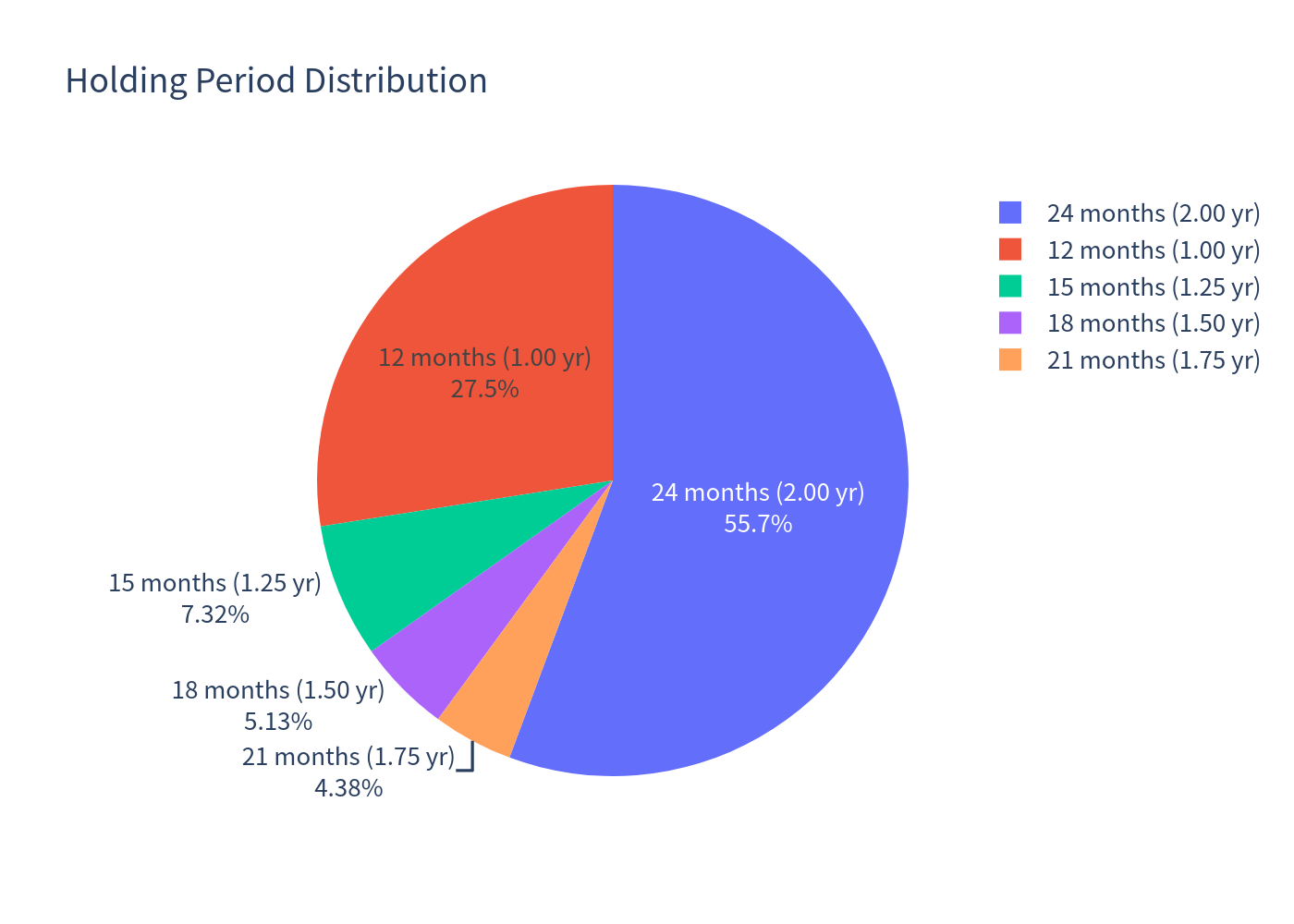
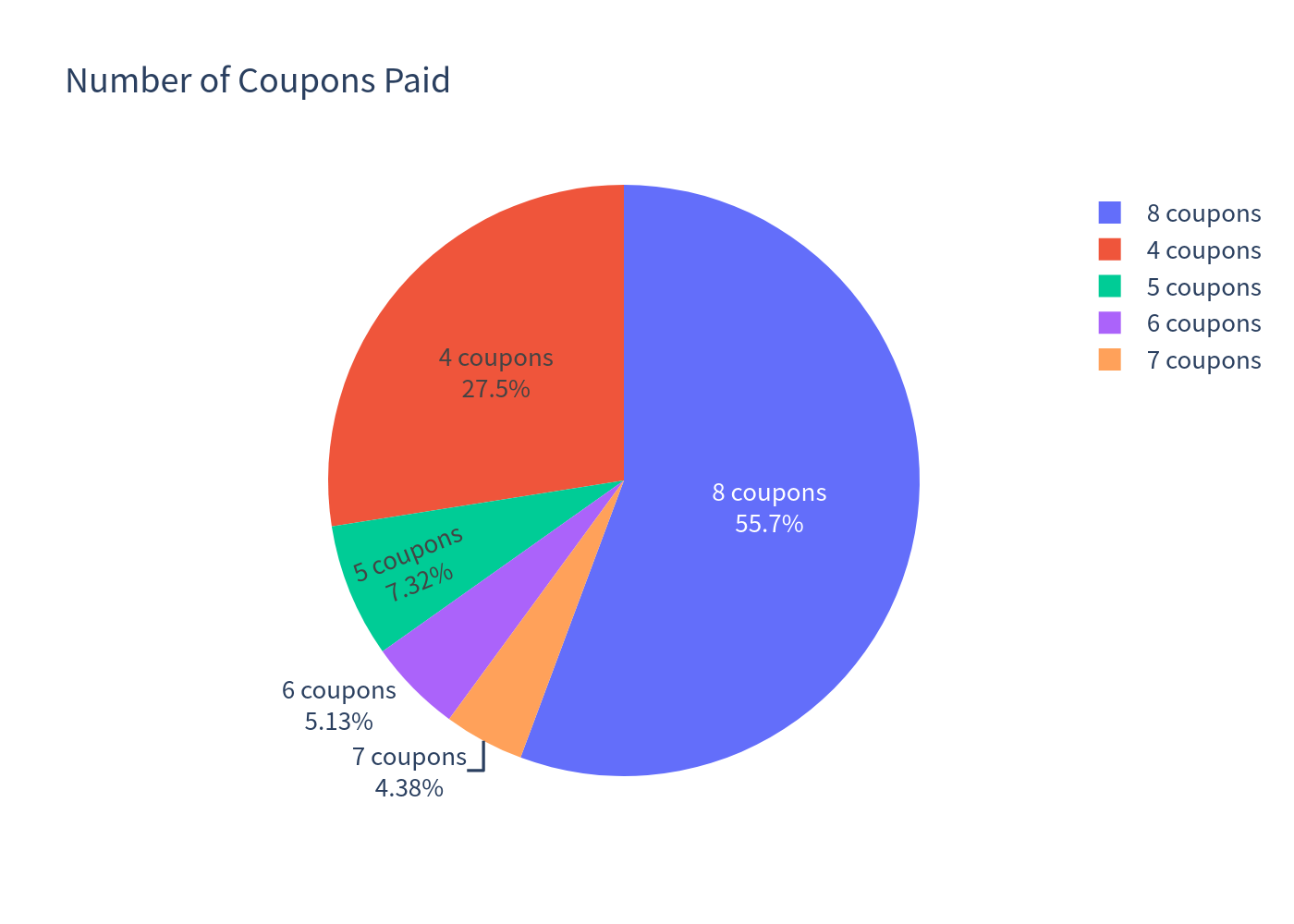
The note ran to maturity in ~56% of paths and was called early in ~44% (most often at the first call date, month 12). A barrier event occurred in ~10.7% of paths. Conditional on a capital loss, the average redemption value was about 60% of par (≈ -40% on capital); the worst simulated redemption was ≈ 31% of par.
Simulation Charts
Product return vs. underlying basket return
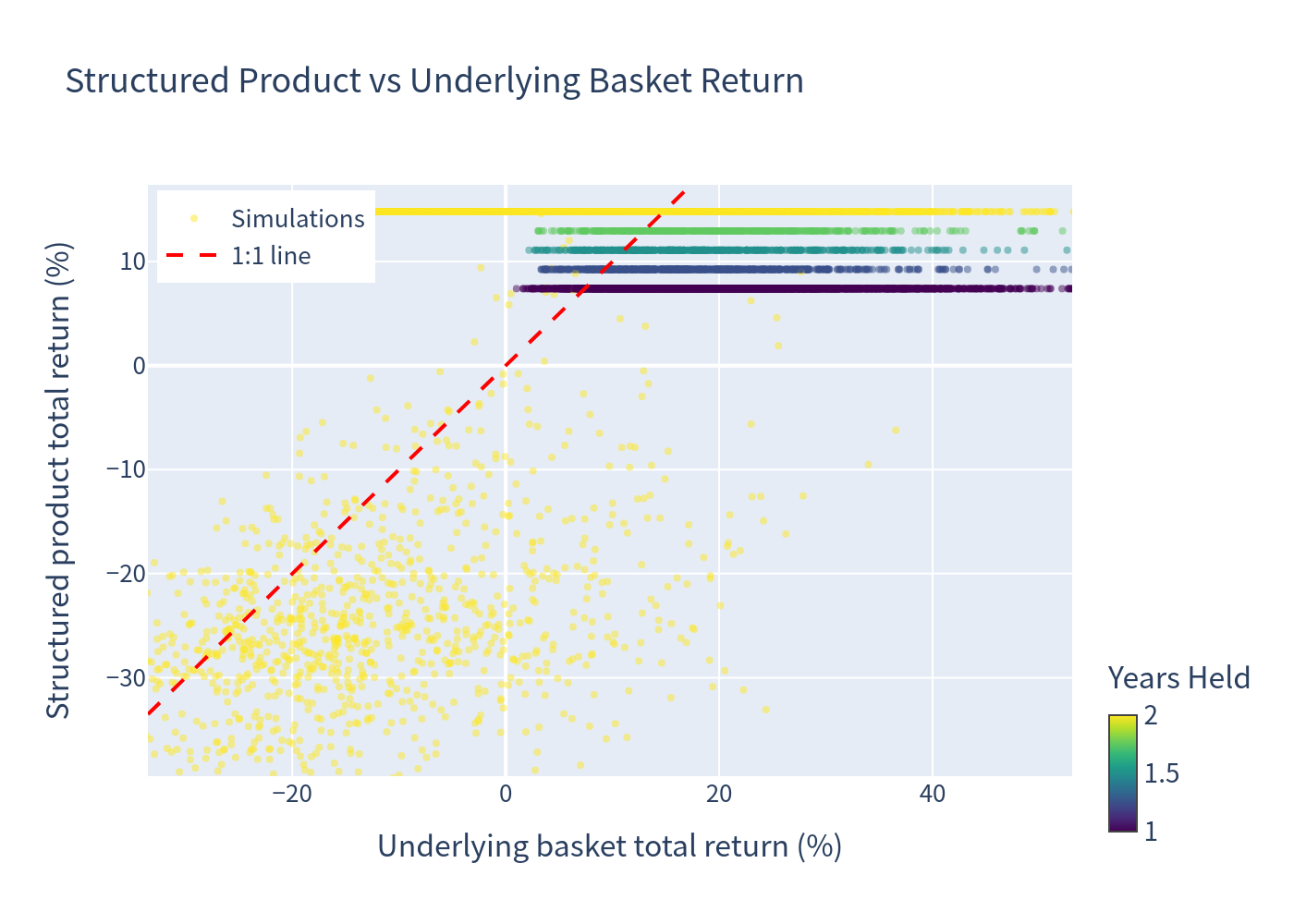
Each point is one simulation, colored by the number of years the note was held. Points sit above the 1:1 line when the basket falls (the buffer/barrier keeps the note near par) and below it when the basket rises (the upside is capped). Short-holding (called) paths cluster at low positive returns; the loss tail appears only on the far-left where the basket also fell sharply.
Annualized return distributions
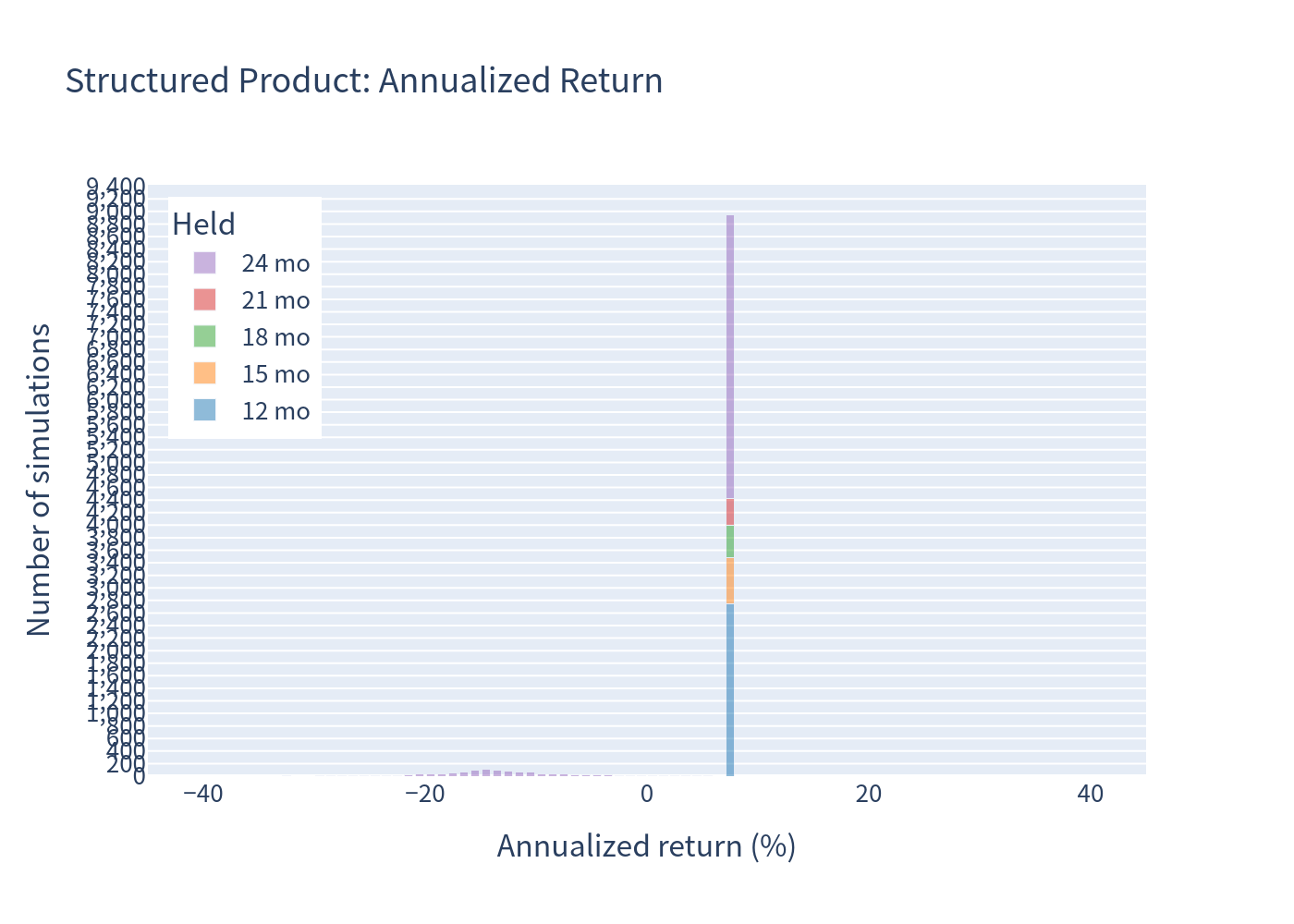
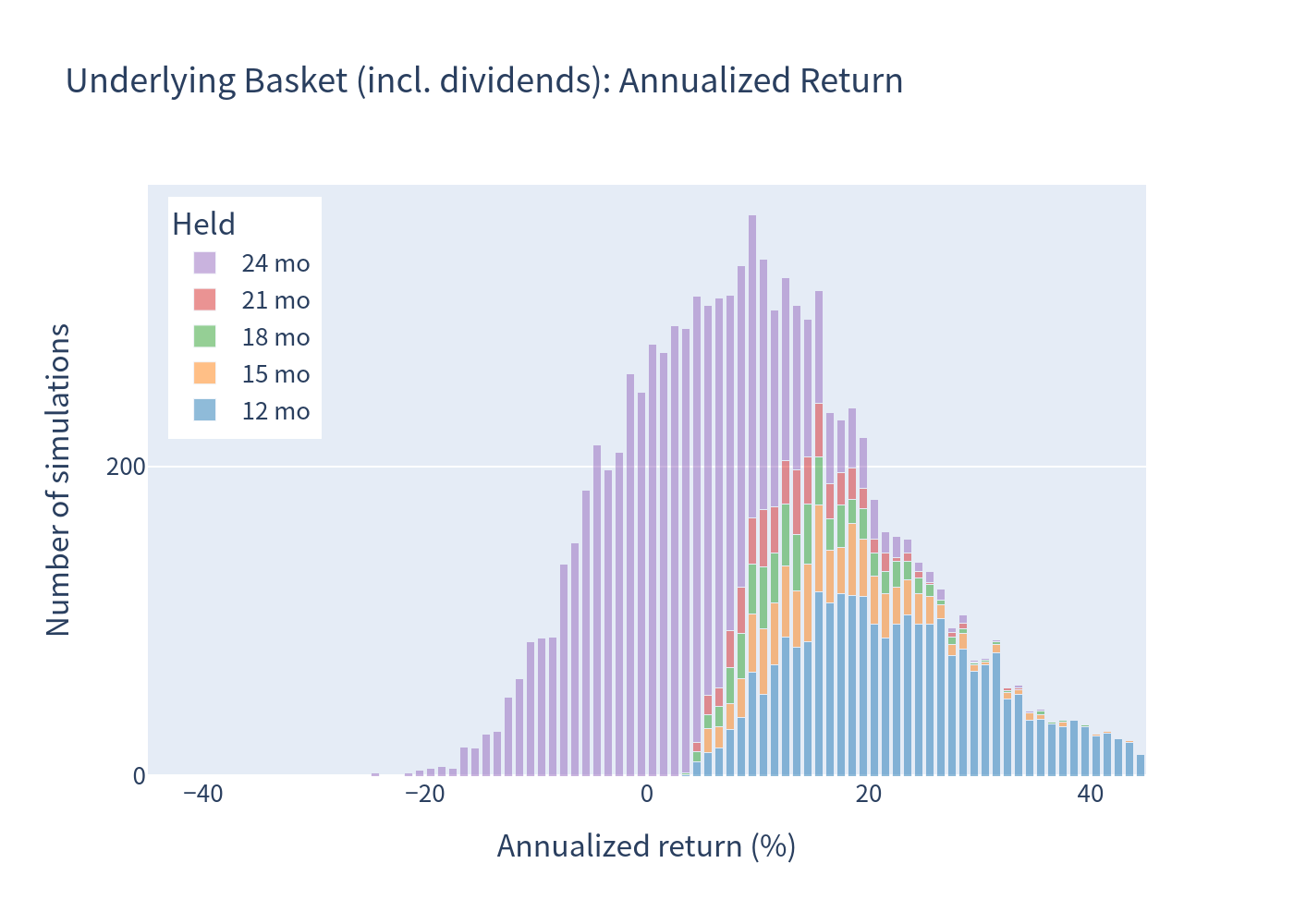
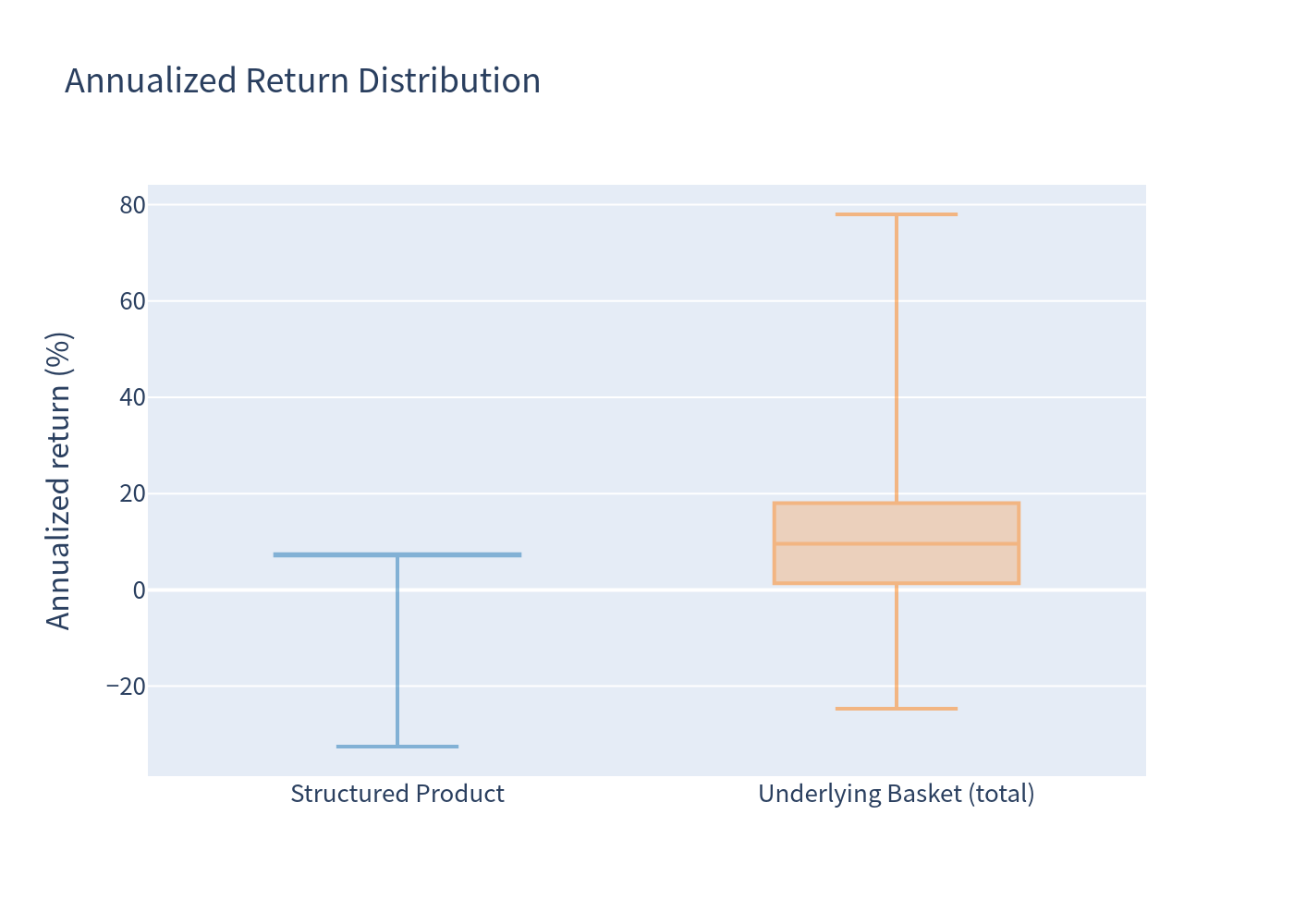
The product's annualized return is concentrated in a narrow band near +7% (the coupon-driven outcome), with a thin loss tail. The underlying basket is far wider, with a much heavier left tail and a longer right tail (upside the note does not capture).
Risk / return comparison
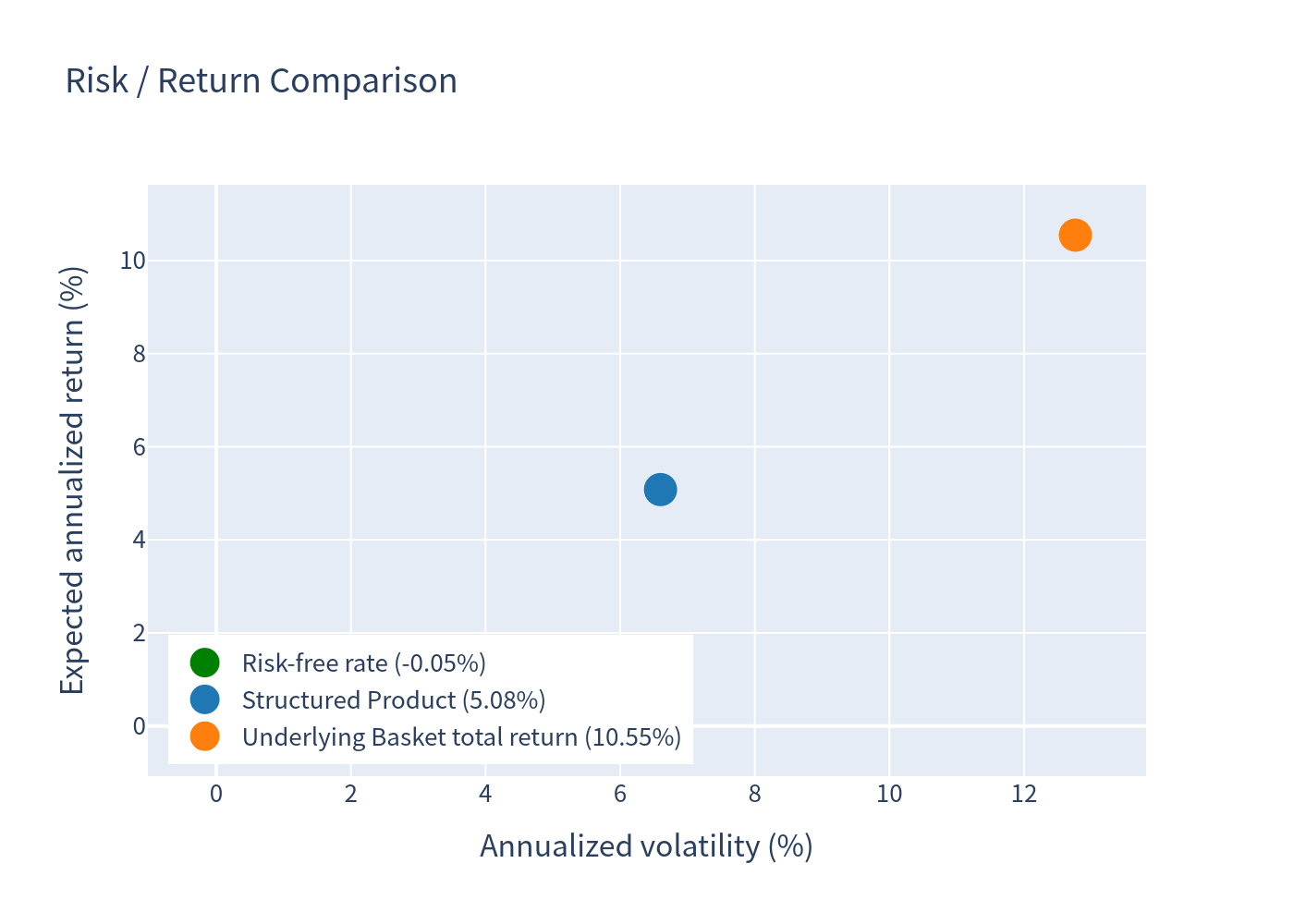
The note sits to the lower-left of the underlying basket: lower expected return and roughly half the volatility — a classic risk-reduction / yield trade-off. It offers a positive expected excess return over the near-zero CHF risk-free rate.
Return distribution (box plot)
Scenario probabilities
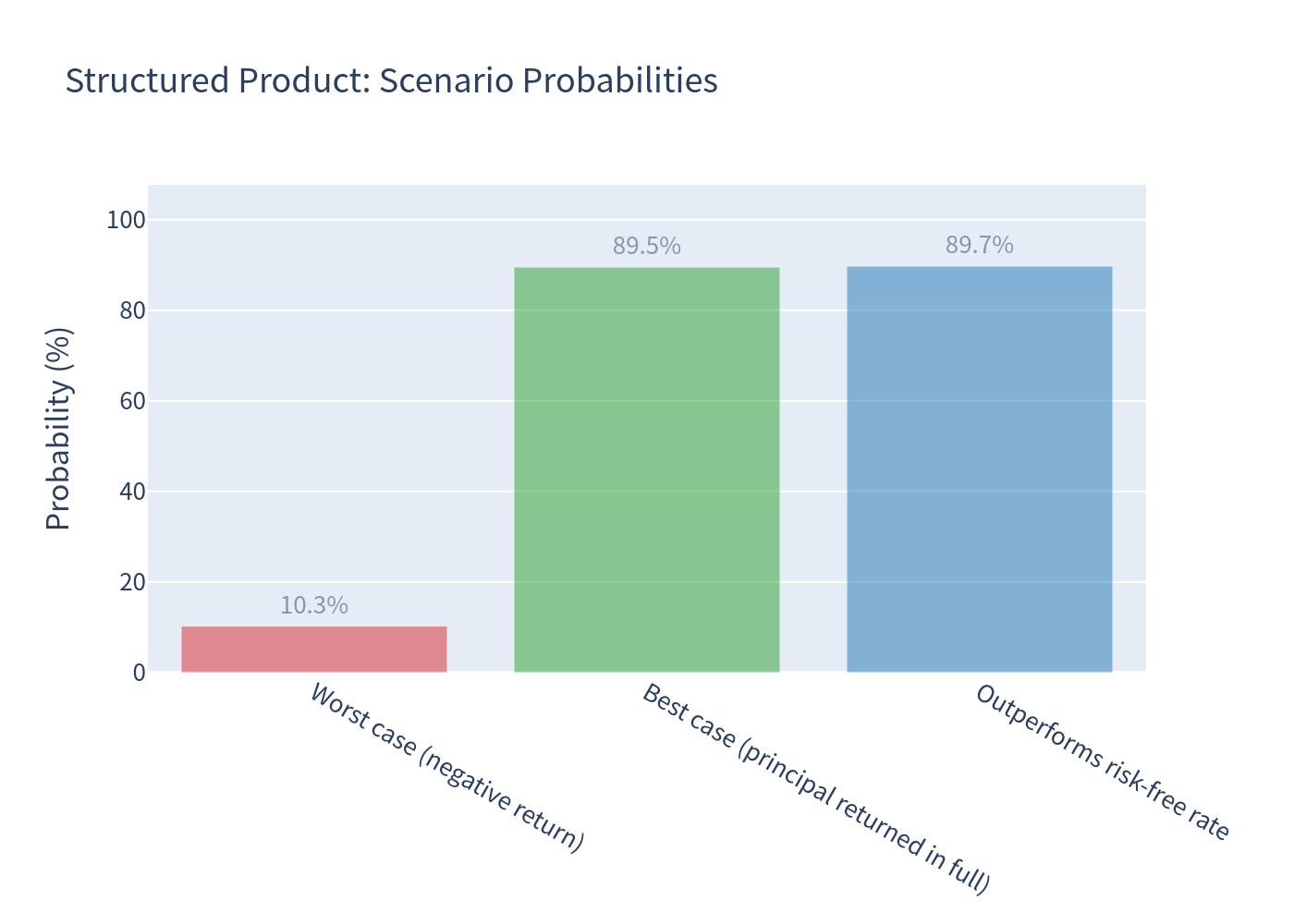
- Worst case (negative return): 10.27%
- Best case (principal returned in full): 89.52%
- Outperforms the risk-free rate: 89.73%
Holding period and coupon count
About 27% of paths are called at the first opportunity (month 12, 4 coupons), while ~56% run the full two years and collect all 8 coupons.
Investment Commentary
Points in favour
- A fixed 7.40% p.a. coupon is paid irrespective of share performance, and the typical outcome (~56% of paths) is the full eight-coupon, par-redemption scenario (annualized ≈ 7%).
- Substantially lower risk than owning the shares: ~6.6% annualized volatility vs ~12.8% for the underlying basket, and a loss probability of ~10% vs ~21%.
- A deep 59% barrier with a recovery feature — even if breached, a worst share that climbs back to its starting level by maturity still returns par.
- Positive expected excess return over the (near-zero) CHF risk-free rate.
Points of caution
- Upside is fully capped: the maximum annualized return equals the coupon (~7.4%); there is no participation in equity gains, and the expected return (5.08%) is below the basket's total return (10.55%).
- Call risk: the issuer can redeem early (~44% of paths), truncating the stream of coupons and pulling the expected return below the headline coupon.
- Downside is real: the barrier is observed continuously over the whole life; when breached and the worst share finishes below its start, the investor takes the full loss (average ~-40% on capital in the loss tail; worst simulated redemption ≈ 31% of par).
- Credit risk of the issuer/guarantor, and secondary-market/liquidity considerations.
The issuer's early-redemption behaviour is discretionary and not described by a contractual trigger; the simulation approximates it by assuming the note is called at the first observation date on which the worst-of level is at or above its starting level. Figures are model-based estimates, not guarantees.