
8.00% p.a. Multi Barrier Reverse Convertible on Nestlé, Novartis & Roche (CHF)
ISIN CH1607594673 · SIX: AIDNTQ · SSPA 1230 · Issue Price 100% · Denomination CHF 1,000 · Issuer Leonteq (Guarantor PostFinance) · 2-year, callable, worst-of, 69% continuous barrier
Headline Simulation Results
Across 10,000 Monte-Carlo scenarios (monthly paths, ~2-year life):
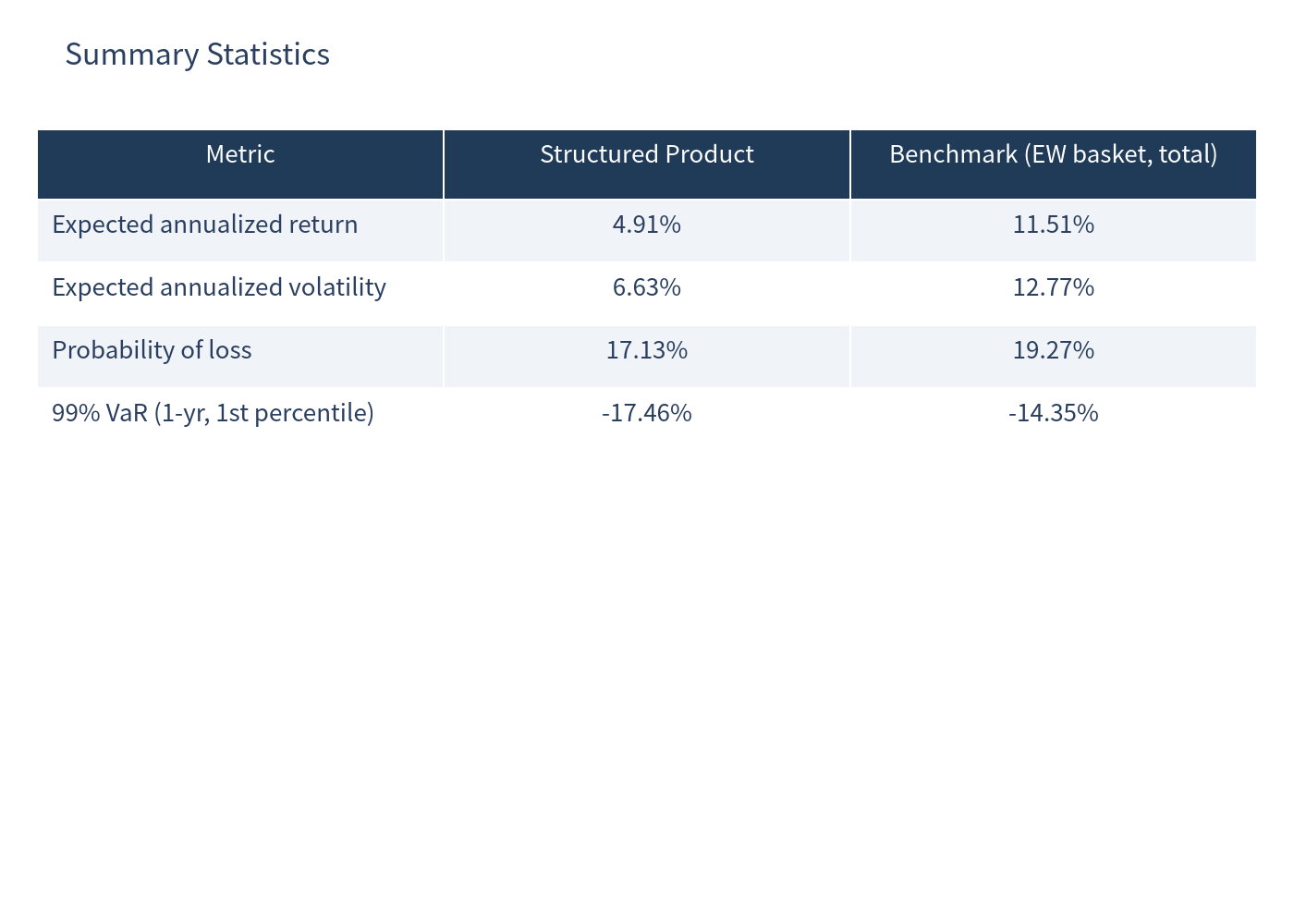
- Expected annualized return: 4.91% (median per-simulation annualized return 7.85%).
- Probability of a negative return: 17.13%.
- 99% confidence VaR (1-year): −17.46% — i.e., in the worst 1% of scenarios the investor's annualized return falls to about −17.5%.
- Expected total return over the holding period: 6.51%, over an expected holding period of ~18.4 months.
- For reference, an equal-weighted buy-and-hold basket of the same three stocks (dividends reinvested, total return) shows an expected annualized return of 11.51% with higher volatility (12.77%) and a 99% VaR of −14.35%.
The gap between the median (≈ full coupon, ~7.7–8% p.a.) and the mean (4.91%) reflects the negative skew: the note wins a modest, capped coupon most of the time but absorbs equity downside in a minority of paths.
| Headline metric | Structured Product | Benchmark basket (total return) |
|---|---|---|
| Expected annualized return | 4.91% | 11.51% |
| Median annualized return | 7.85% | 11.06% |
| Expected annualized volatility | 6.63% | 12.77% |
| Probability of loss | 17.13% | 19.27% |
| 99% VaR (1-yr, 1st percentile) | −17.46% | −14.35% |
Product at a Glance — How It Works
You invest CHF 1,000 (100% of the denomination) for a maximum of about two years.
- Fixed coupon, rain or shine. Every quarter the note pays a coupon of CHF 20 (= 2.0%, i.e. 8.00% p.a.), regardless of how the three stocks move — as long as you still hold the note. Over the full term that is 8 coupons = 16.0 points on a 100 notional.
- Downside protection via a 69% barrier (continuously watched). If none of Nestlé, Novartis or Roche ever trades at or below 69% of its starting level during the whole life, you get your full 100% back at maturity (plus the coupons).
- What happens if the barrier is breached. Once any one of the three stocks touches 69%, the "protection" is knocked out. At maturity your principal then follows the worst-performing stock: if that worst stock has recovered to at least its starting level, you still receive 100%; if it ends below its starting level, you receive that stock's shares (or cash equivalent) and realise a loss in line with its fall.
- Issuer call option. The issuer may call (redeem) the note early on four quarterly dates beginning after one year. If called, you receive your 100% back plus that period's coupon, and the note ends — so strong markets cap how many coupons you collect.
- Upside is capped. You do not participate in the stock's gains beyond the fixed coupon.
In short, the 8% coupon is manufactured by selling downside protection (a short worst-of put with a 69% knock-in) and selling the upside (capped participation plus an issuer call).
Key Statistics
- Underlyings: Nestlé (NESN), Novartis (NOVN), Roche (RO) — three defensive Swiss blue chips; equal-weighted average dividend yield ≈ 3.09% (Nestlé 3.76%, Novartis 2.97%, Roche 2.55%).
- 20-year annualized volatilities: Nestlé ≈ 17.7%, Novartis ≈ 19.6%, Roche ≈ 21.7%.
- CHF short-term risk-free rate used as the reference: ≈ 0% (1-year average of Swiss 3-month interbank rate, −0.04%).
- Worst-of level at the end of the holding period: median ≈ 101, 5th percentile ≈ 63.
Simulation Outcomes
Product return vs benchmark basket return (each point = one simulation)
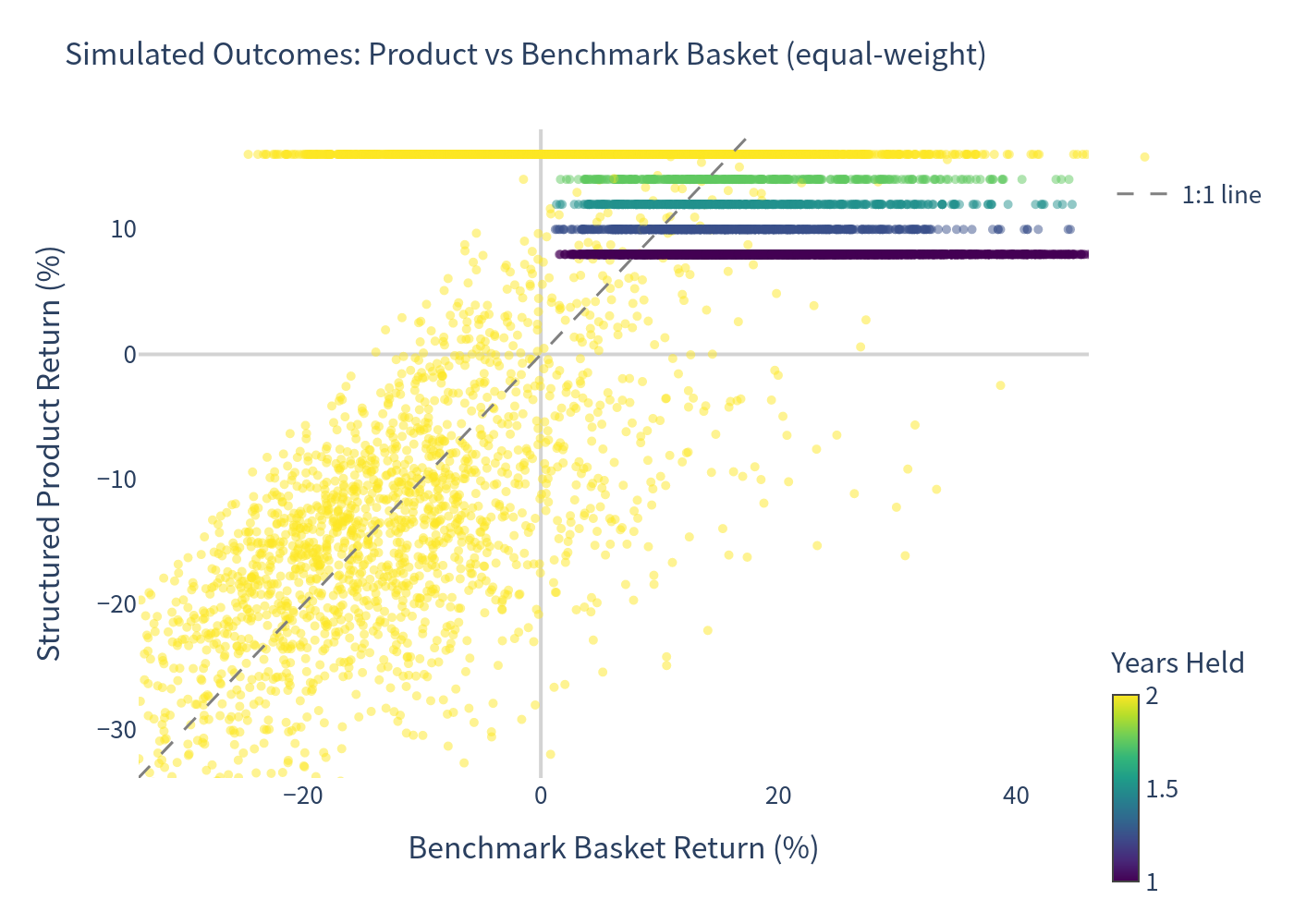
Most points sit in the upper-left region (product ~7–8% while the basket is flat-to-down) — the coupon cushions you when stocks stall — while the lower-right cloud shows scenarios where the basket rallied but the product's upside was capped by the call. The loss quadrant (bottom-left) captures barrier events.
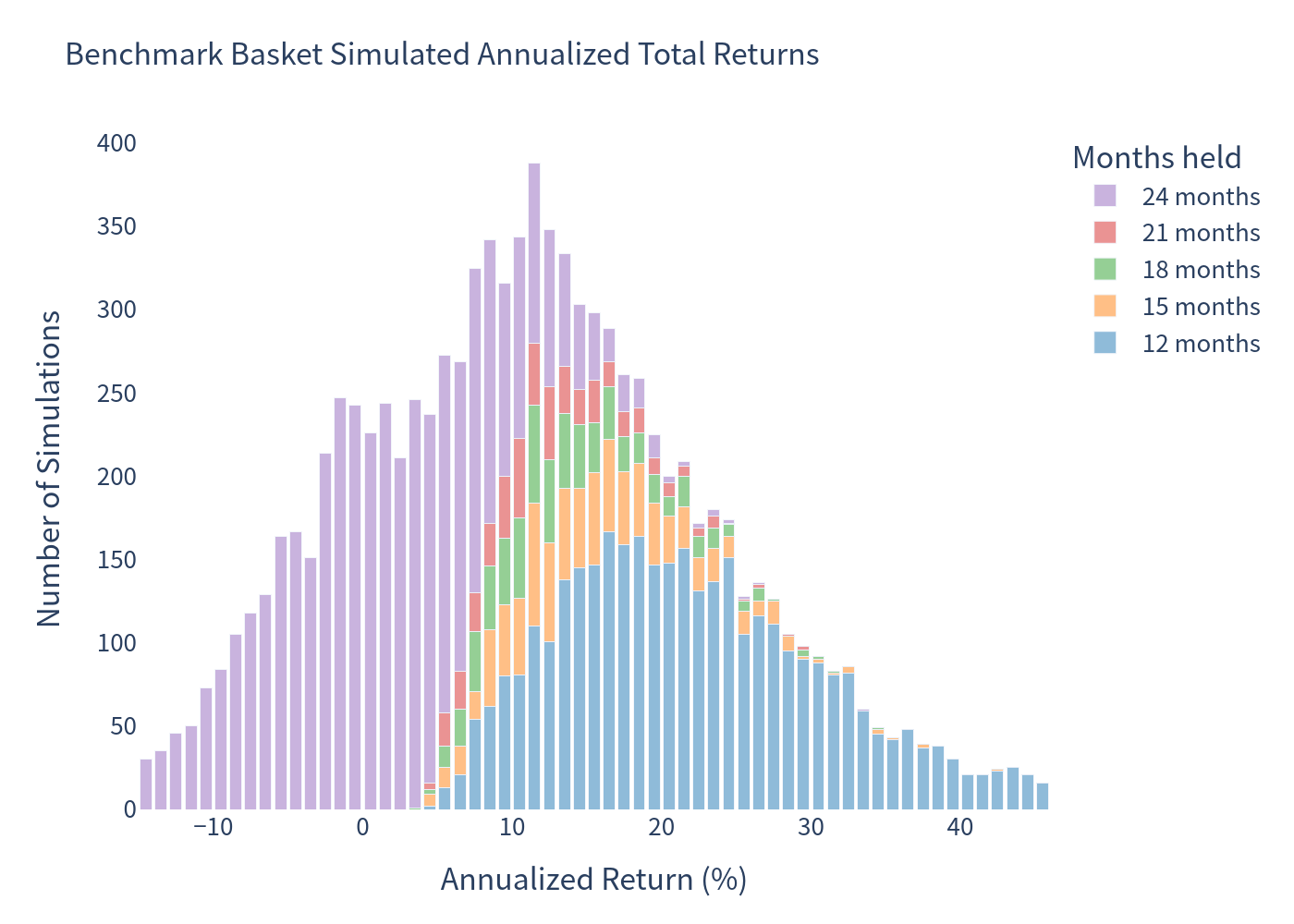
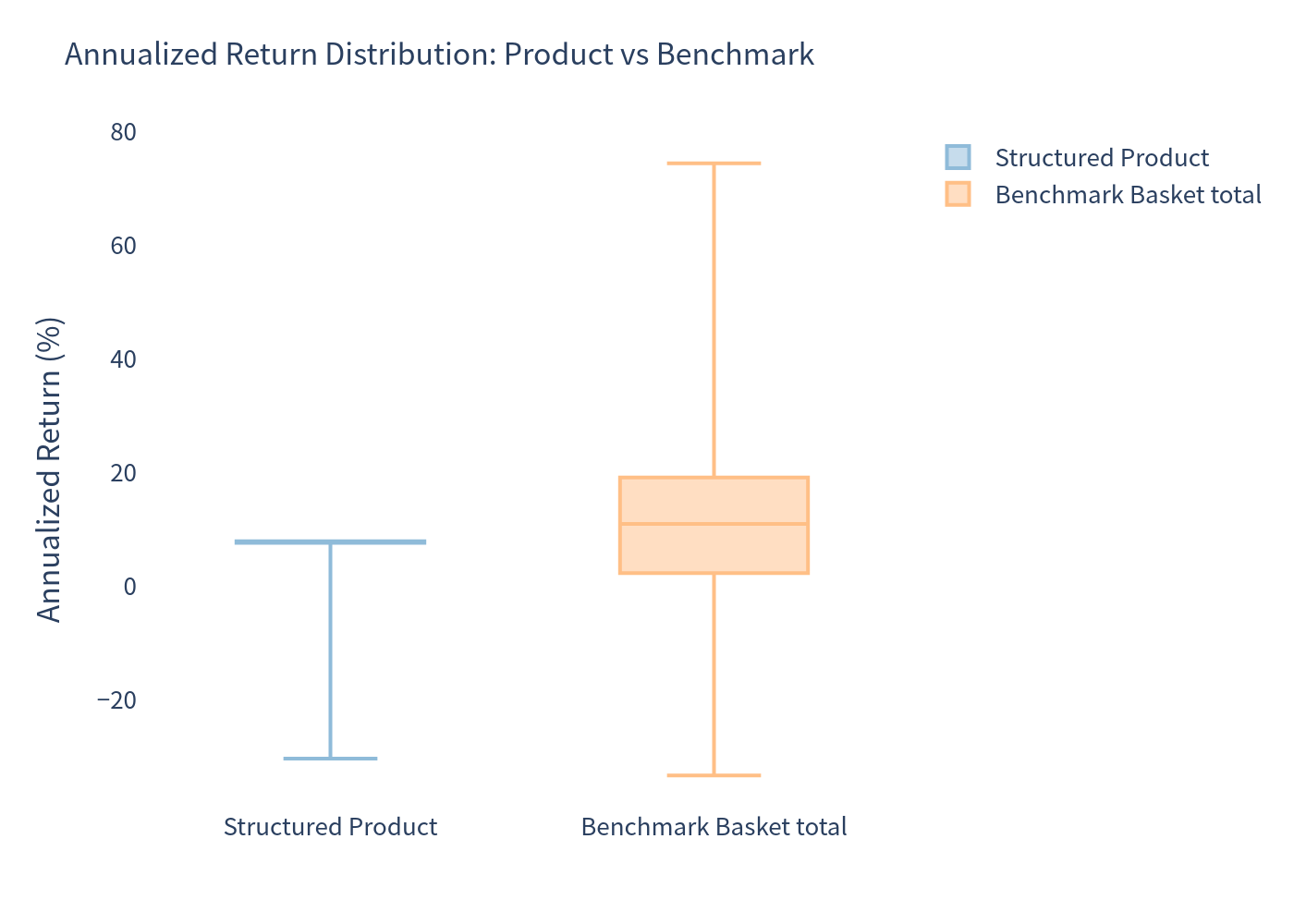
Distribution of benchmark basket annualized total returns (1% bins, coloured by holding period)
Distribution of structured product annualized returns (1% bins, coloured by holding period)
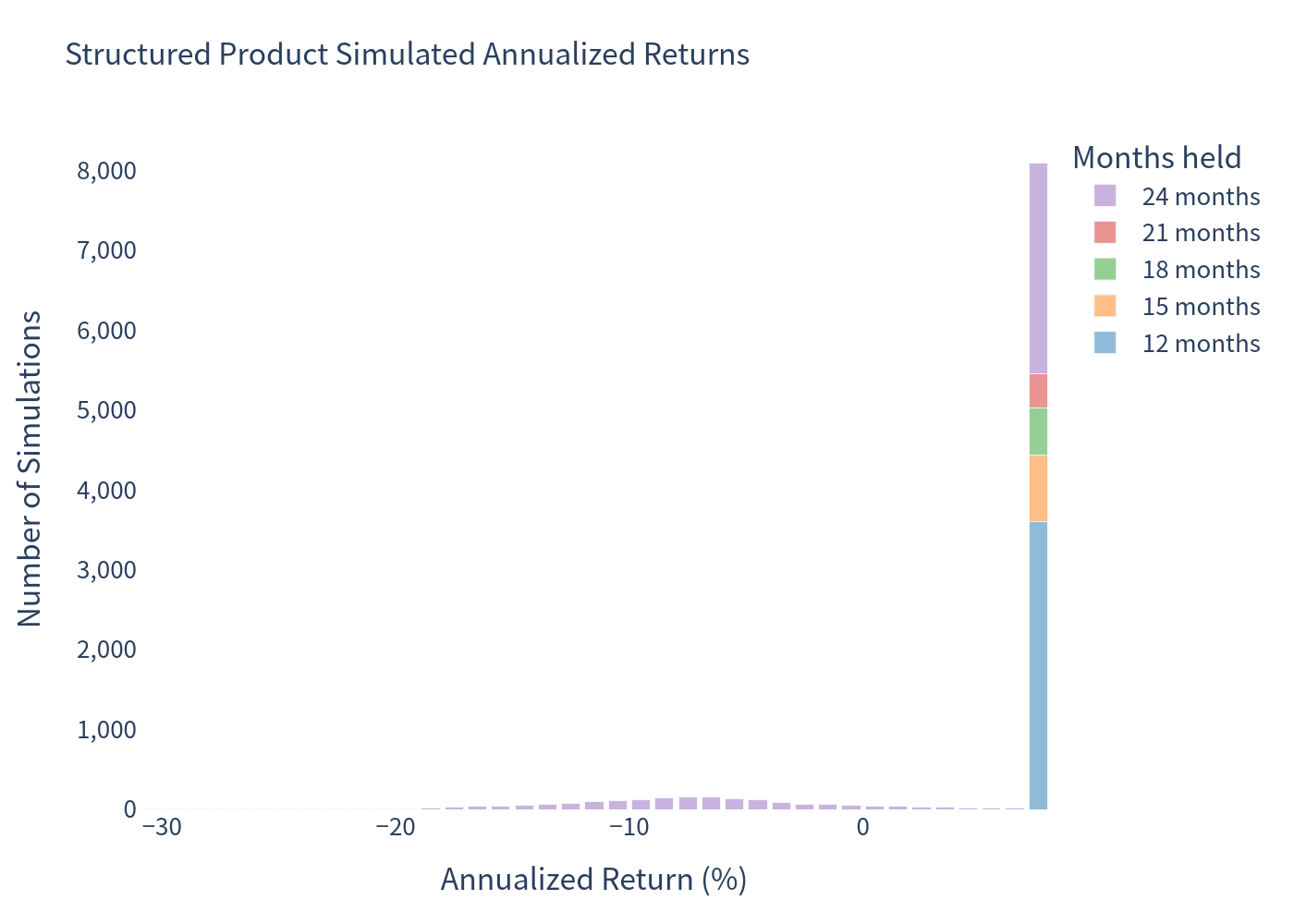
The large spike near +7.7–8.0% is the dominant "collect the full coupon" outcome (≈81% of scenarios). The left tail to roughly −30% arises when the barrier is breached and the worst stock finishes well below its start.
Scenario Probabilities
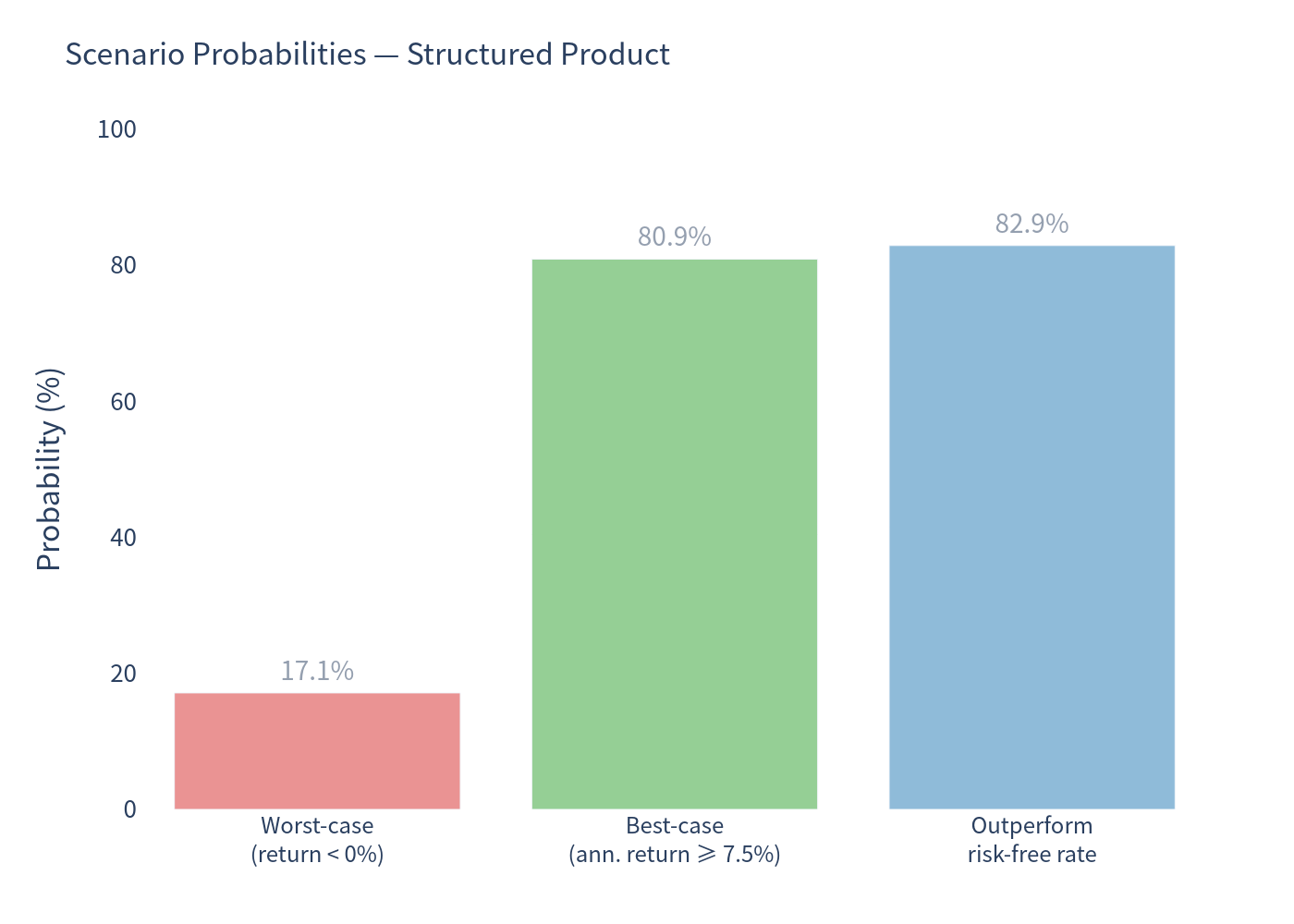
- Worst case (total return < 0): 17.13%.
- Best case (annualized return ≥ 7.5%, i.e. essentially the full coupon): 80.92%.
- Beats the risk-free rate (~0%): 82.91%.
Risk / Return
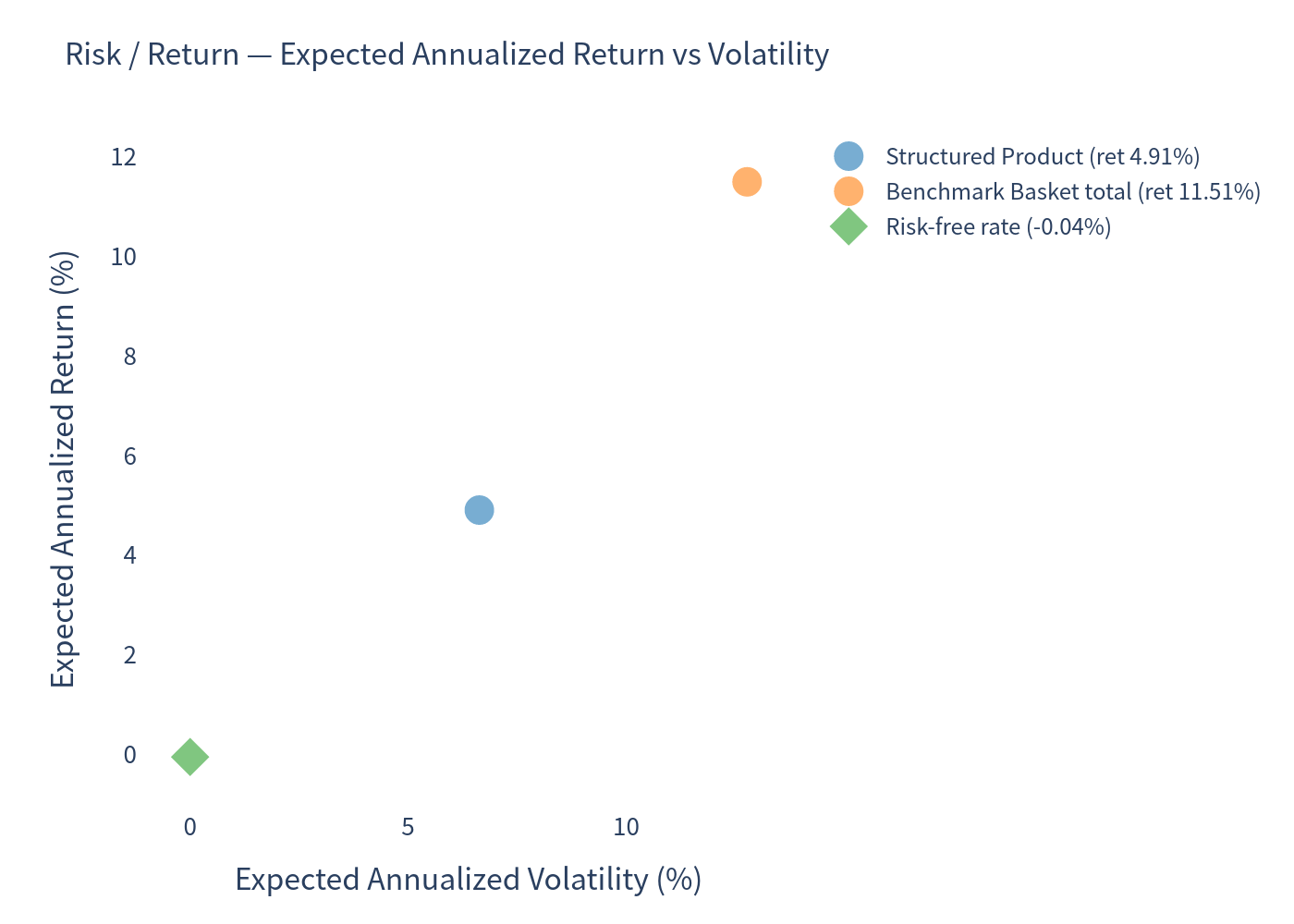
The note delivers roughly half of the benchmark's volatility (6.63% vs 12.77%) because the coupons and barrier truncate most of the distribution — but it also gives up most of the upside, so its expected return (4.91%) sits well below the equity basket while still comfortably above cash.
Holding Period & Coupon Outcomes
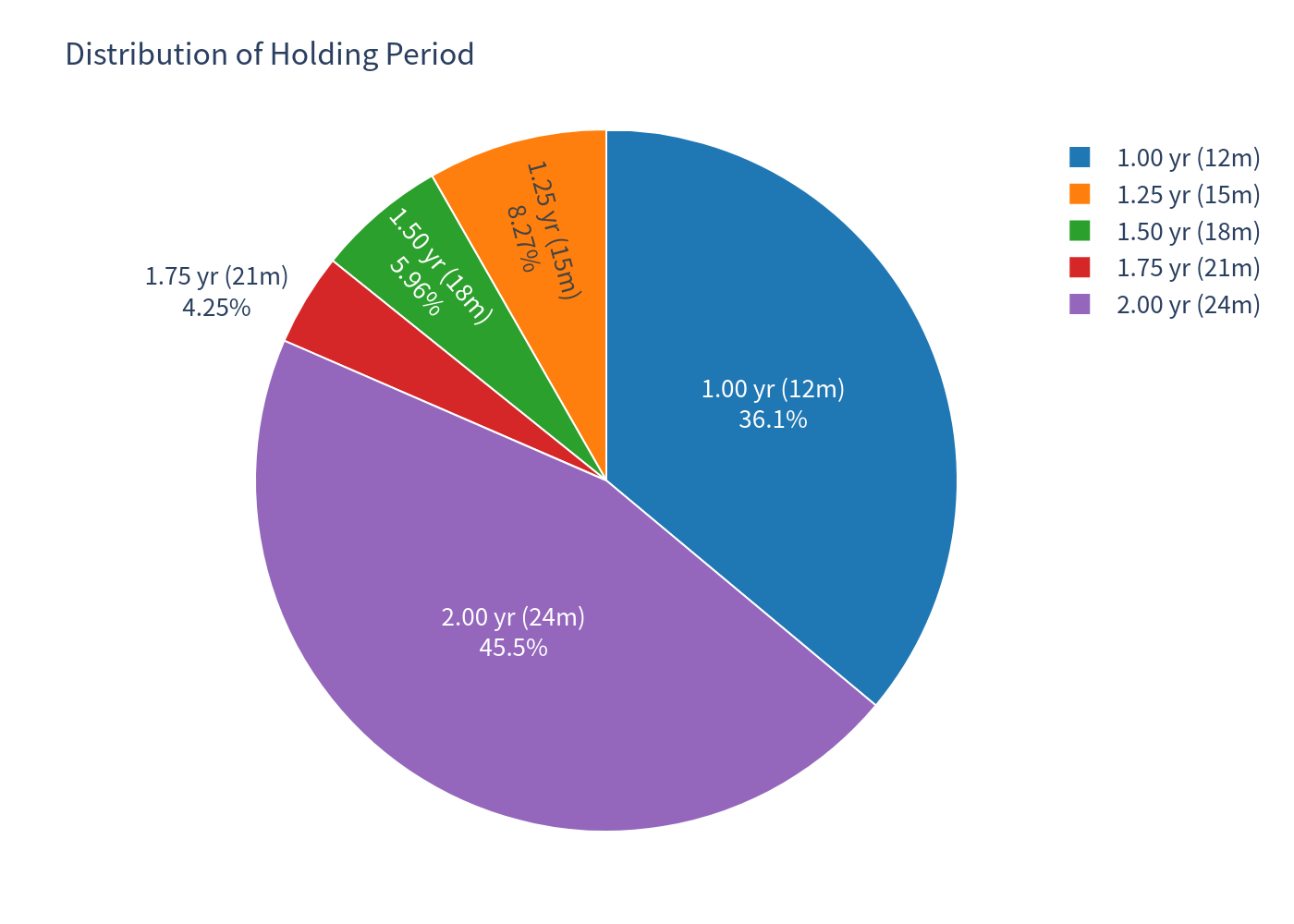
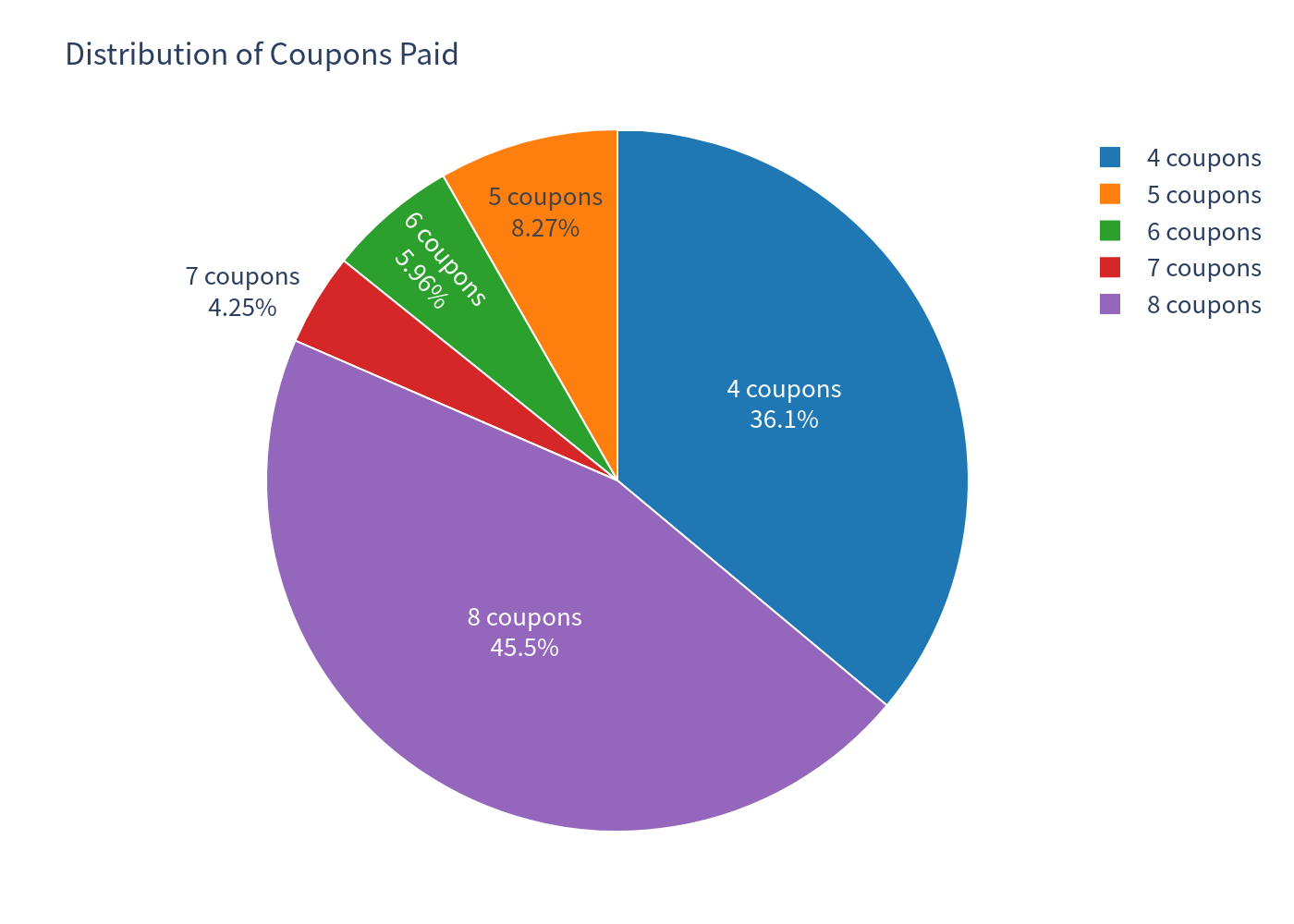
- Called early: 54.55% of paths (most — 36.07% — at the first call date after 12 months), held to maturity: 45.45%.
- Because (in this model) calls occur when the worst stock is at or above its start — a modelling assumption for the issuer's discretionary call — early redemption clusters in rising markets, precisely when a buy-and-hold investor would have earned more.
Investment Commentary
Strengths (positive characteristics)
- An 8.00% p.a. coupon paid quarterly irrespective of market direction, highly attractive versus ~0% CHF cash and negative Swiss policy rates; ~83% of scenarios beat cash.
- A meaningful cushion: with 16 points of cumulative coupons, the investor only loses money if the worst stock finishes below about 84% of its start — i.e. the coupons lift the break-even from the 69% barrier up to ≈84%, leaving a sizeable cushion even after a knock-in.
- The 69% barrier is far (a 31% buffer) and all three names are low-beta defensive Swiss staples/healthcare with strong balance sheets.
- High probability (~81%) of capturing the full coupon, with roughly half of the equity basket's volatility.
- Diversification across three large, liquid SIX-listed issuers.
Limitations / risks to weigh
- Upside is fully capped and the issuer call cuts the coupon stream short in strong markets (54% called early), so participation in a rally is lost.
- Worst-of payoff is more punitive than the average of the three names; a single weak stock dictates the downside.
- The 69% barrier is continuous, so a brief intraday dip triggers the knock-in and the loss-of-principal branch — the 17% loss probability carries a heavy left tail (99% VaR −17.46% annualized, down to ≈−30% total in extreme cases).
- Expected return in this simulation (4.91%) materially trails a plain equal-weight basket (11.51%) — the price of the cushion, the cap and the call feature.
- Standard issuer/credit risk (Leonteq, rated BBB−, guaranteed by PostFinance AA).