
Structured Product Analysis Report
9.80% p.a. Multi Barrier Reverse Convertible — Coca-Cola / McDonald's / Starbucks
Headline Simulation Results
| Metric | Value |
|---|---|
| Expected annualized return | 7.85% |
| Expected total return (realized holding period) | 7.17% |
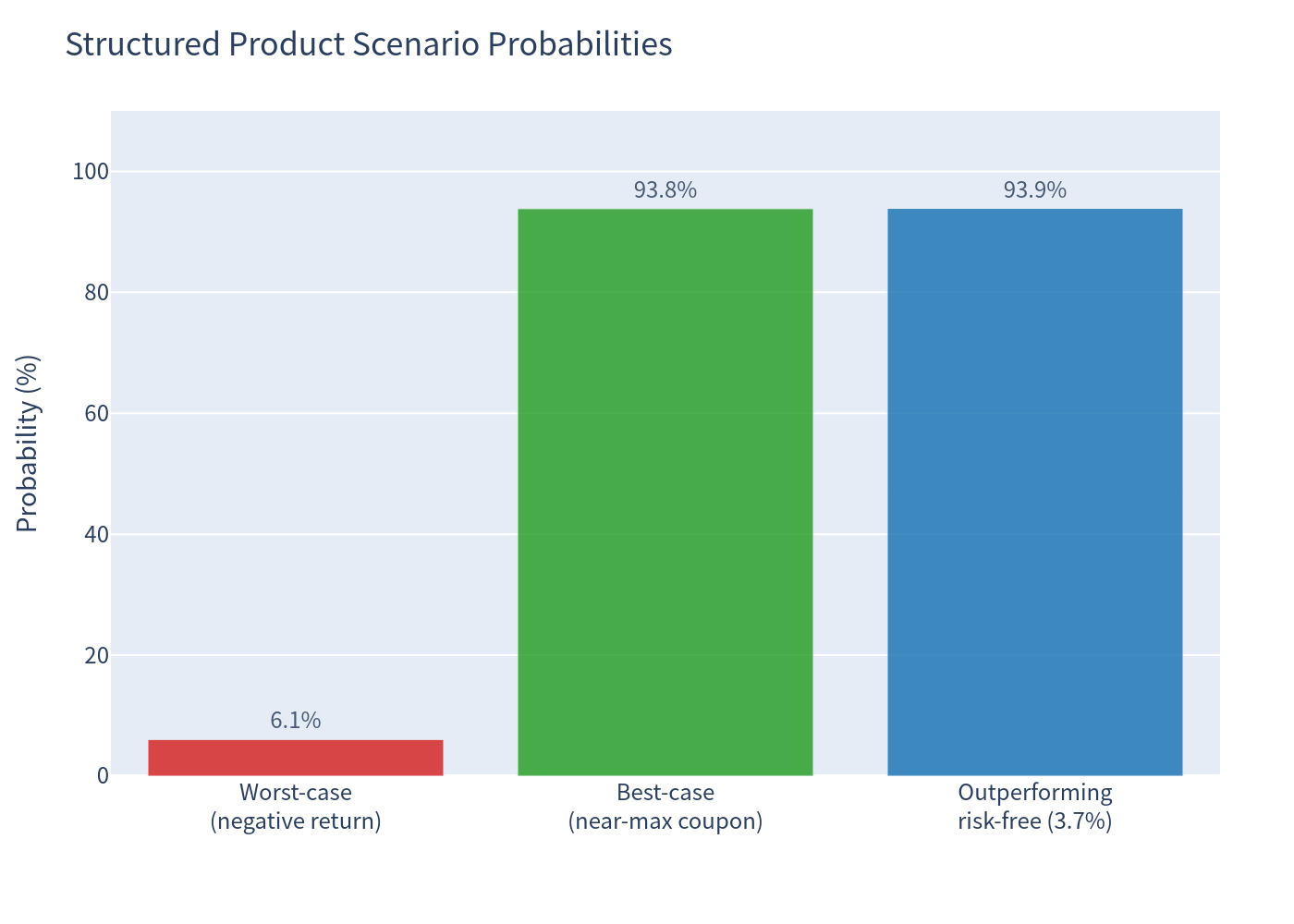
| Probability of negative return | 6.06% |
| 99% confidence VaR (1 year) | -28.34% |
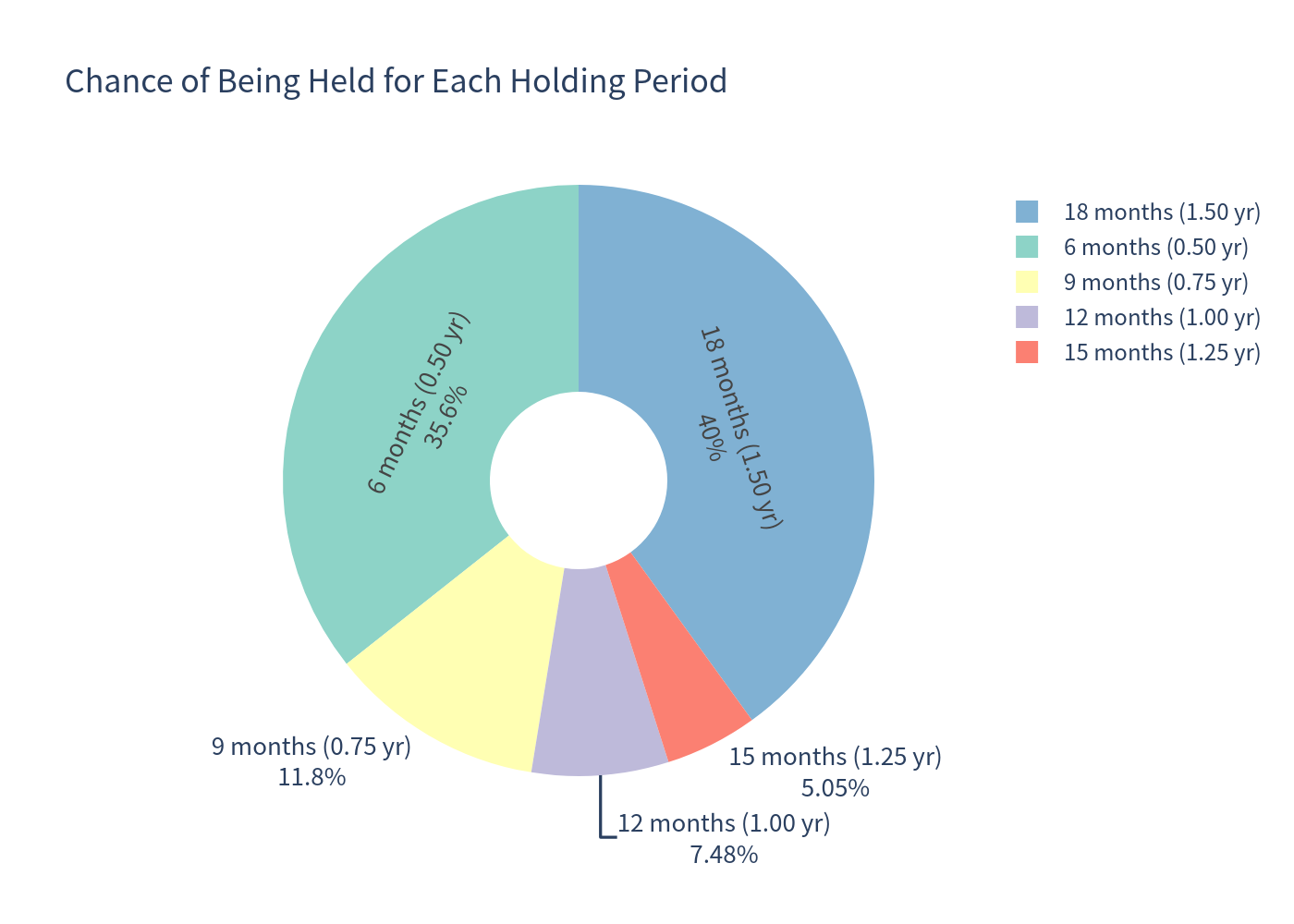
| Expected holding period | 12.06 months |
Basic Product Information
How it works (layman's explanation)
This is a callable multi-barrier reverse convertible on three US consumer stocks — Coca-Cola (KO), McDonald's (MCD) and Starbucks (SBUX). The investor pays USD 1,000 per product and receives a fixed quarterly coupon of USD 24.50 (2.45%) regardless of how the stocks perform — six coupons in total (14.70% if held to maturity), i.e. a coupon rate of 9.80% p.a.
In exchange for this high coupon, the investor takes on conditional downside exposure:
- Downside protection: As long as none of the three stocks ever falls to or below 55% of its initial fixing level (a ~45% buffer) during the whole life of the product, the investor gets their full USD 1,000 back at maturity, plus all coupons.
- If the barrier is breached (any one stock trades at/below 55% of initial): at maturity, if the worst-performing stock is below its initial level (strike = 100%), the investor receives shares of the worst-performing stock instead of cash — the value of which equals 100 × the worst stock's performance (i.e. the investor shares the downside of the weakest name). If the worst stock is above its initial level, the investor still gets full par back.
- Issuer callable: The issuer (Basler Kantonalbank) has the right to call the product early at each quarterly observation date (months 6, 9, 12, 15). If called, the investor receives par plus the coupon for that date. We model the issuer as calling as soon as the worst-performing stock is back at or above its initial level (the embedded put is then worthless and the issuer stops paying the coupon).
- Upside is capped: Returns are capped at the fixed coupons; the investor does not participate in any stock upside.
Key product parameters: Notional USD 1,000 · Coupon 9.80% p.a. (quarterly) · Barrier 55% of initial (continuous observation) · Strike 100% of initial · Term ~18 months (Sep 2026 – Mar 2028) · ISIN CH1555865505 · Issuer Basler Kantonalbank (S&P AA+ / Fitch AAA).
Key Statistics
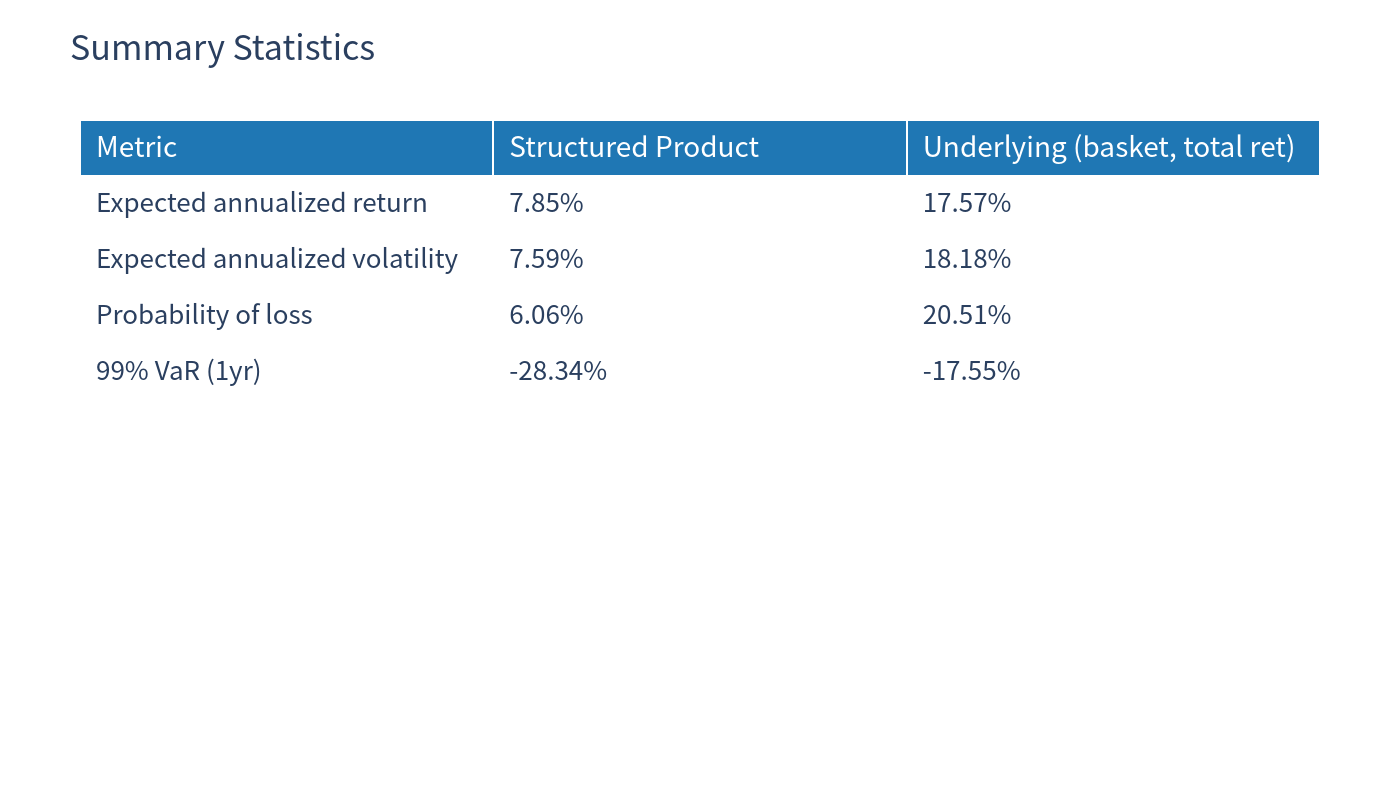
| Metric | Structured Product | Underlying Basket (total return) |
|---|---|---|
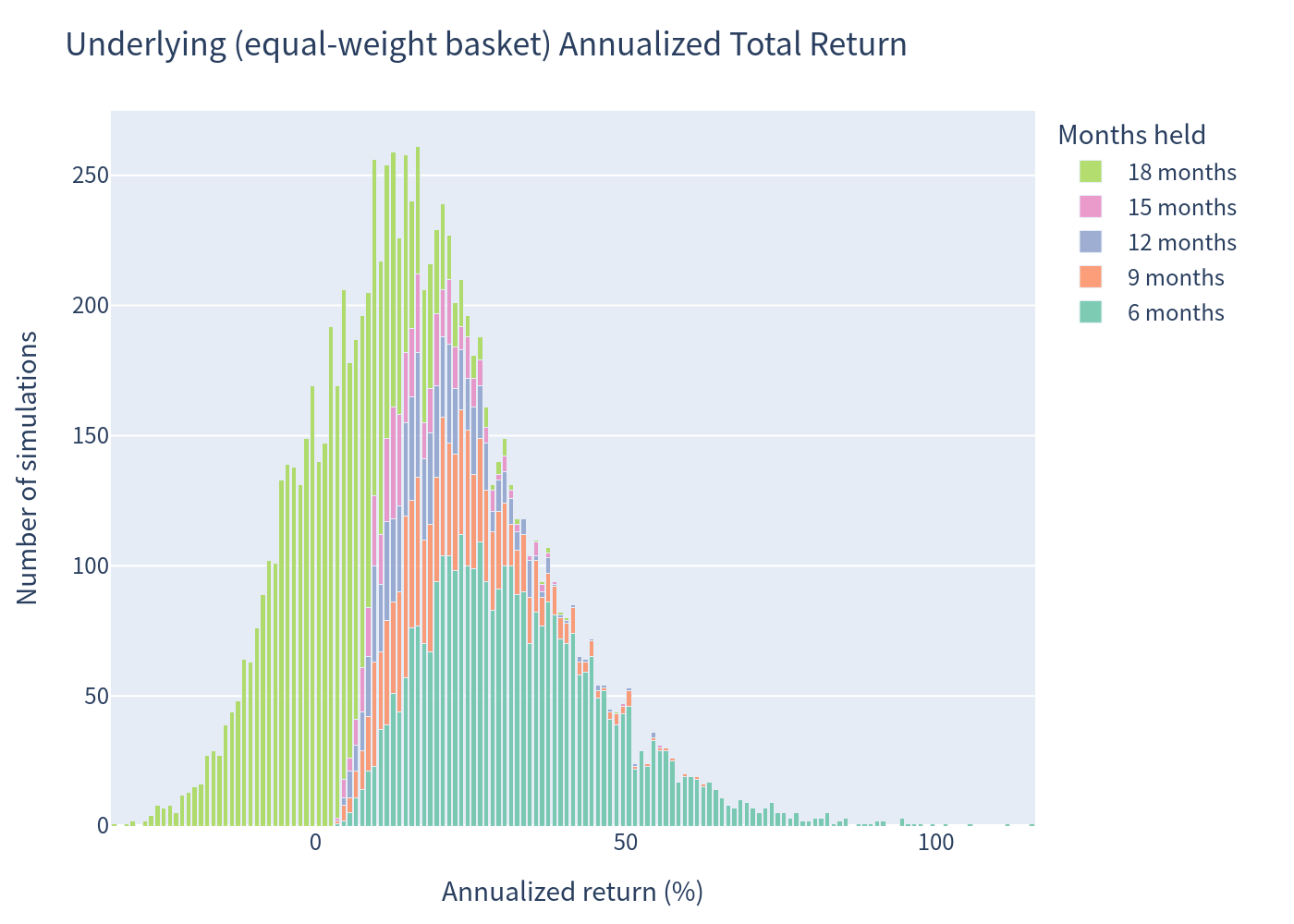
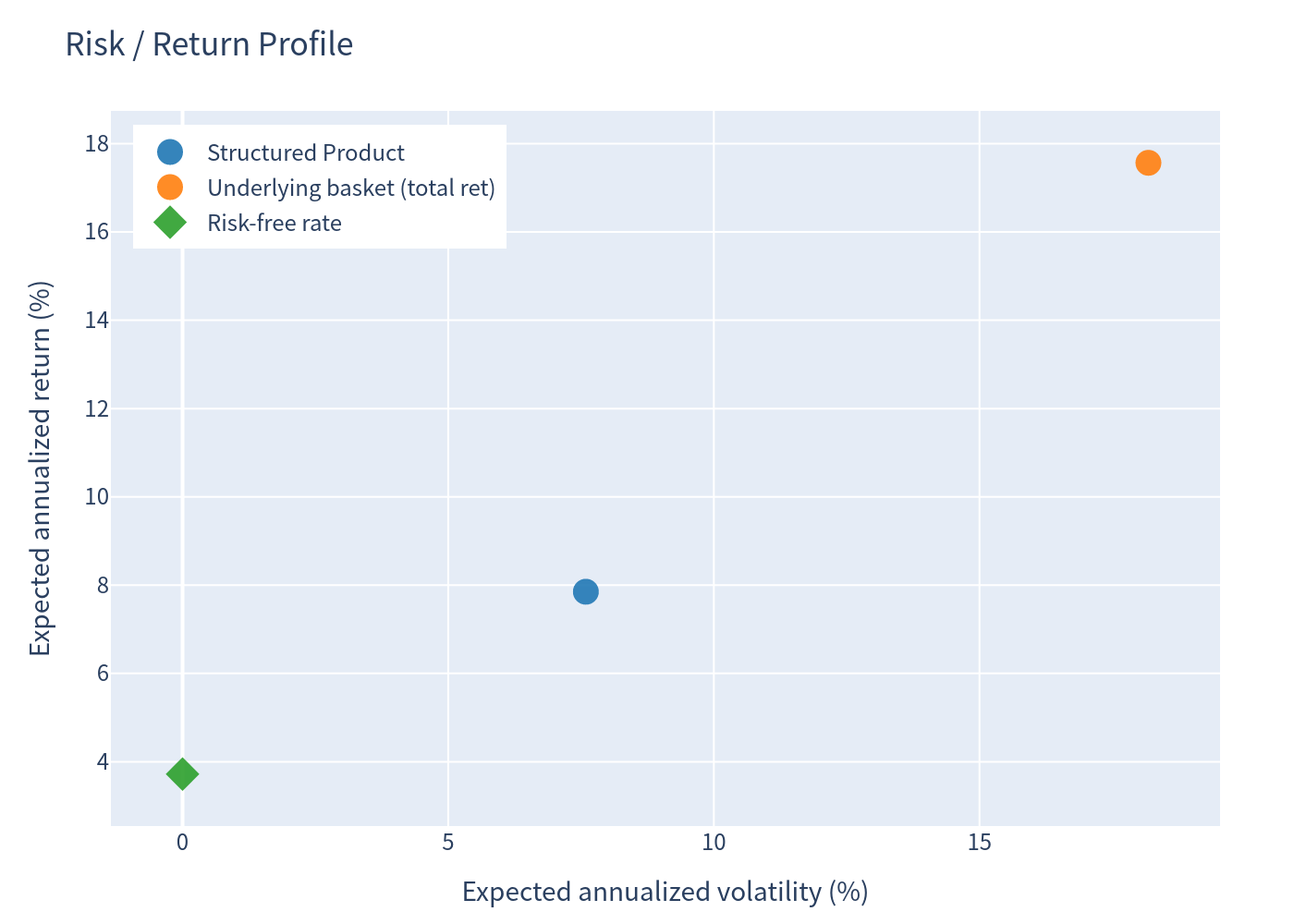
| Expected annualized return | 7.85% | 17.57% |
| Expected annualized volatility | 7.59% | 18.18% |
| Probability of loss | 6.06% | 20.51% |
| 99% VaR (1 year) | -28.34% | -17.55% |
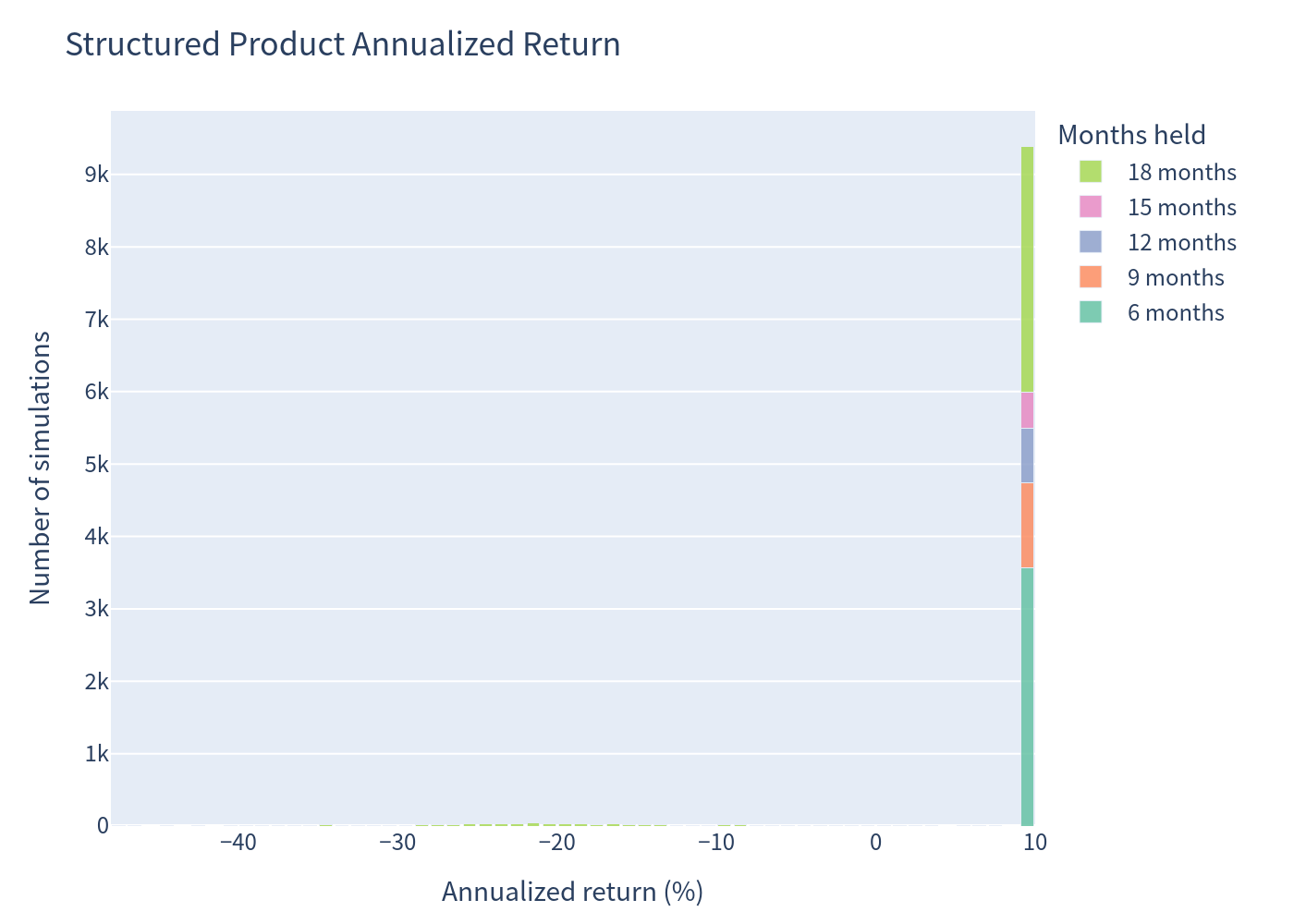
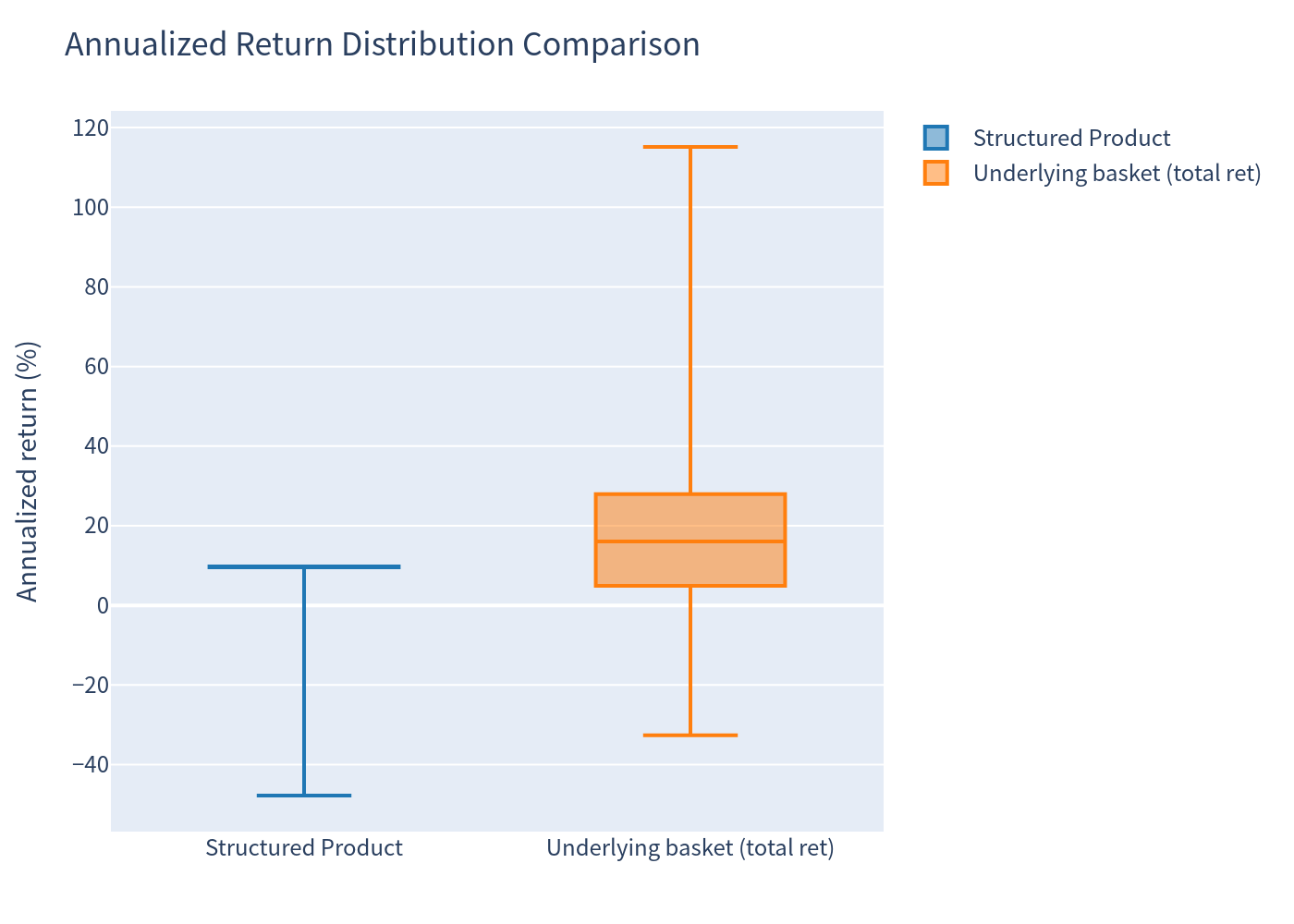
| Median annualized return | 9.80% | 16.03% |
Holding period & coupon outcomes
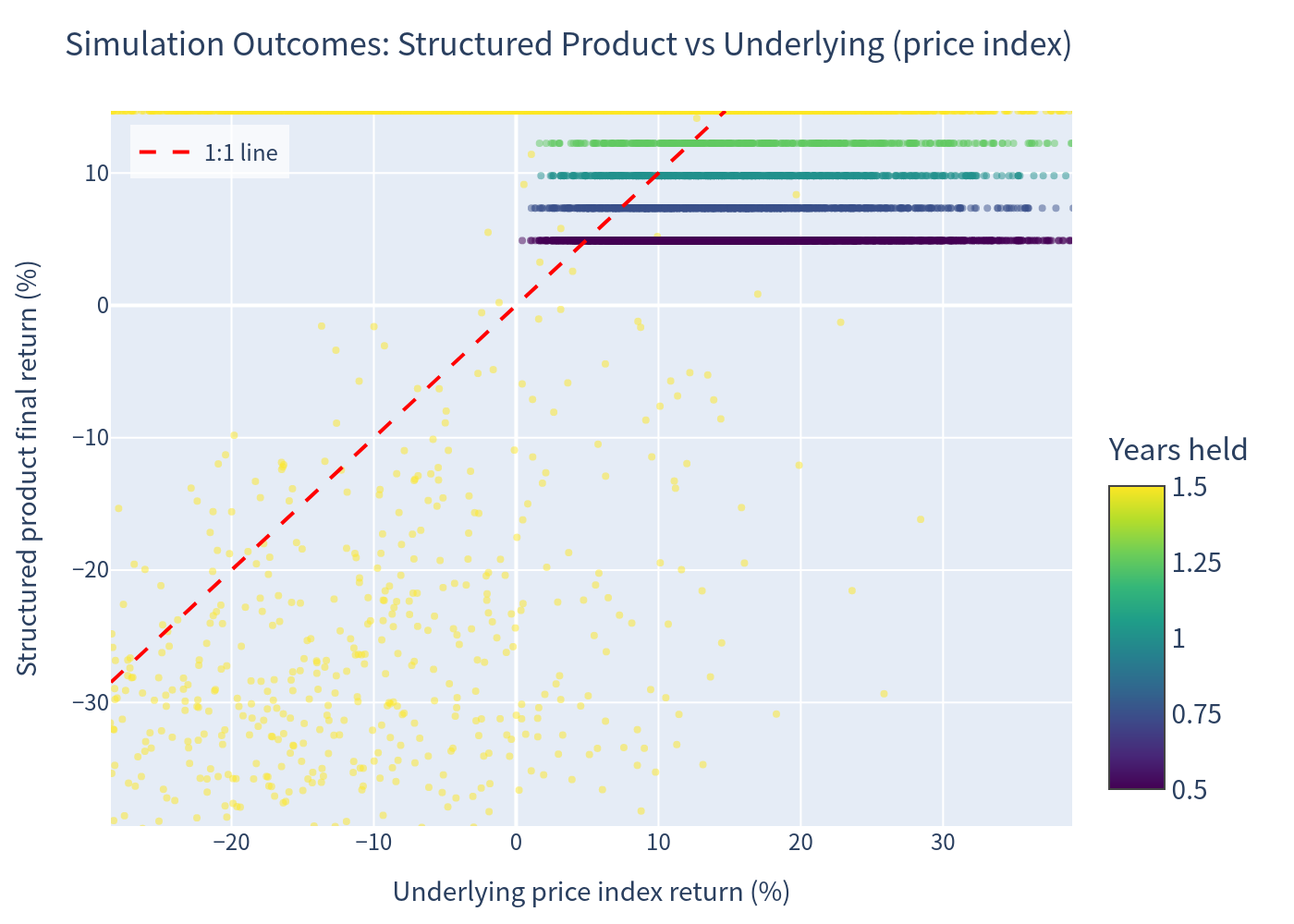
- Called early / held to maturity: ~60% of simulations are called early by the issuer; ~40% run to maturity.
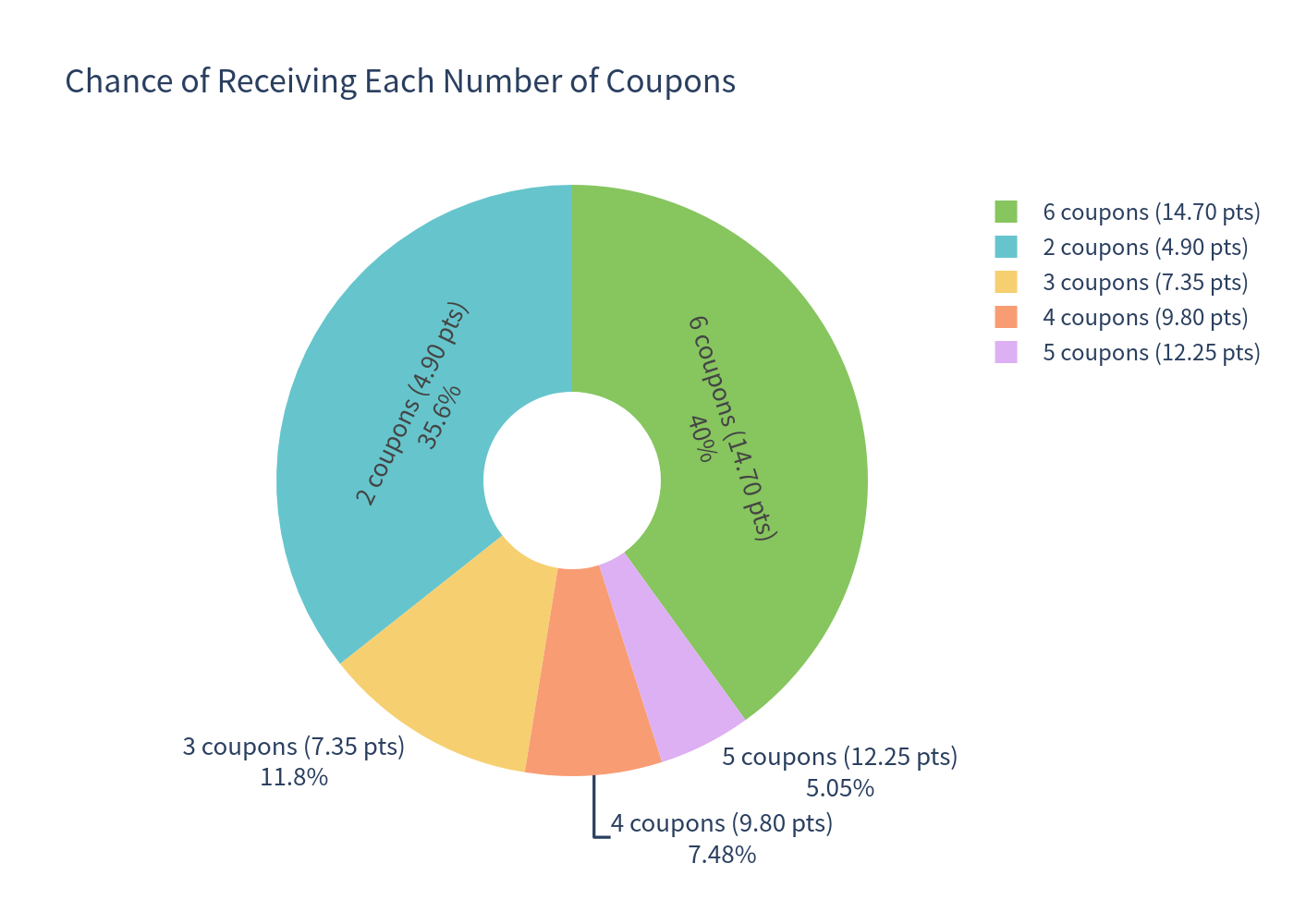
- Coupons received: 2 coupons (35.65%), 3 (11.79%), 4 (7.48%), 5 (5.05%), 6 (40.03%).
- Barrier breach (continuous observation): ~6.6% of simulations; physical delivery of the worst-performing stock occurs in ~6.2% of simulations.
- Outperforming the risk-free rate: 93.88% probability.
Charts
Simulation Outcomes (Scatter)
Scatter of simulated holding-period outcomes for the structured product.
Annualized Return Distribution — Underlying Basket
Distribution of annualized returns for the equal-weighted KO / MCD / SBUX basket (total return, incl. dividends).
Annualized Return Distribution — Structured Product
Distribution of annualized returns for the structured product across simulated scenarios.
Scenario Probabilities
Probability of key scenarios: called early, held to maturity, barrier breached, physical delivery.
Risk / Return Profile
Risk-return positioning of the structured product versus the underlying basket.
Annualized Return Comparison (Box Plot)
Box-plot comparison of annualized return distributions — structured product vs. underlying basket.
Holding Period Distribution
Distribution of realized holding periods (early call vs. maturity).
Coupon Count Distribution
Distribution of the number of coupons received across simulations.
Summary Statistics
Tabular summary of key simulation statistics.
Investment Commentary
Key strengths of this product
- Attractive fixed coupon: 9.80% p.a. (14.70% total if held to maturity), paid quarterly and independent of underlying performance — coupons are also paid on the early-redemption date if the product is called.
- Deep downside buffer: the 55% barrier (≈45% below initial) with continuous observation provides conditional capital protection; in ~93% of simulated scenarios the barrier is never breached.
- Favourable risk profile: the product exhibits materially lower annualized volatility (7.59% vs 18.18%) and a much lower probability of loss (6.06% vs 20.51%) than direct investment in the equal-weight basket, while still delivering a high coupon.
- High probability of outperforming cash: ~93.9% of scenarios beat the 1-year USD risk-free rate (3.72%).
- Quality names: the underlying basket (Coca-Cola, McDonald's, Starbucks) consists of large-cap defensive consumer names with meaningful dividend income (average ~2.48%) if shares are delivered.
Key risk considerations (factual)
- The main loss scenario is a worst-of barrier breach: if any single stock falls below 55% of its initial level and the worst performer is below its strike at maturity, the investor receives shares of the weakest stock, and losses can be substantial (the 99% VaR of -28.34% reflects such tail scenarios).
- Returns are capped at the coupon; the investor forgoes upside participation.
- The product is issuer callable, so the effective holding period and total coupon income are uncertain (expected ~12 months / ~4 coupons).
- The product is a debt instrument of the issuer; investors are exposed to issuer credit risk (Basler Kantonalbank, S&P AA+ / Fitch AAA).