
8.00% p.a. Callable Multi Barrier Reverse Convertible (Worst-of) on AXA, Helvetia Baloise & Zurich Insurance — Quanto CHF
A yield-enhancement note that pays a fixed 8.00% p.a. quarterly coupon (CHF 20 per CHF 1,000) and offers conditional capital protection, at the cost of giving up any upside and accepting a worst-of equity downside.
Headline Simulation Results
| Metric | Value |
|---|---|
| Expected annualized return | 2.71% |
| Expected total return over realised holding period | -0.38% |
| Expected holding period | 12.78 months (approx. 1.06 yrs) |
| Probability of a negative return | 25.27% |
| 99% confidence VaR (1 year) | -28.52% |
| Expected annualized return of underlying (total return, incl. dividends) | 17.85% |
What This Product Is and How It Works (plain language)
- You lend CHF at a fixed 8% p.a. Interest (the coupon) is paid every quarter, and is paid no matter what the three share prices do.
- A "barrier" gives conditional protection. As long as none of AXA, Helvetia Baloise or Zurich Insurance ever trades at or below 69% of its starting level (continuously monitored) during the life of the note, you receive your CHF 1,000 back at the end — even if the shares finish down, provided they never breached 69%.
- The catch is the "worst-of" clause. If any one of the three shares breaches its 69% barrier at any moment, the protection disappears. At maturity you then receive the worst-performing share's decline: if the weakest share is below its starting level, you take that loss (physical-style delivery), i.e. you can lose a large part of your principal.
- No upside. Your maximum gain is the coupons. If the shares double, you still only receive par plus coupons.
- The issuer can call it early. From month 6 onward, on each quarterly date the issuer may redeem the note at par plus the coupon. In strong markets this happens quickly, cutting the coupon stream short.
Key Statistics
| Strategy | Expected annualized return | Expected annualized volatility | Probability of loss | 99% VaR (1 year) |
|---|---|---|---|---|
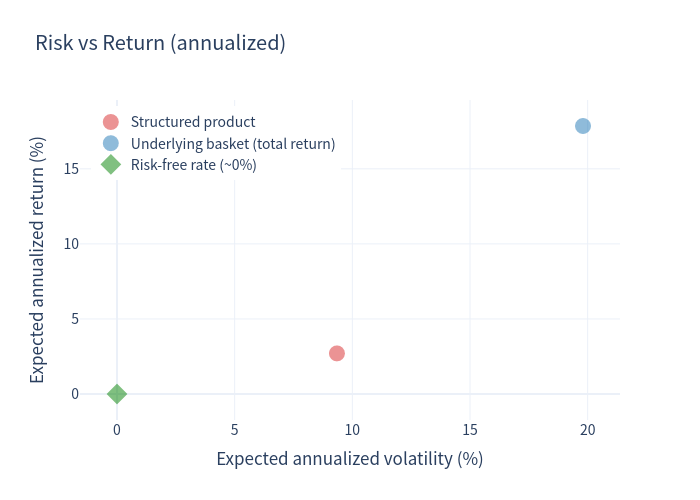
| Structured product (incl. coupons) | 2.71% | 9.35% | 25.27% | -28.52% |
| Underlying basket — price only | 13.29% | 19.80% | 24.76% | -28.10% |
| Underlying basket — total return (incl. dividends) | 17.85% | 19.80% | 18.50% | -23.53% |
Other simulation facts
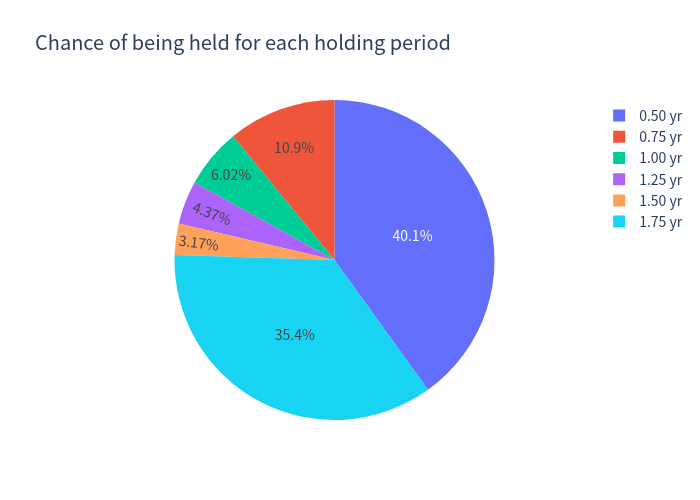
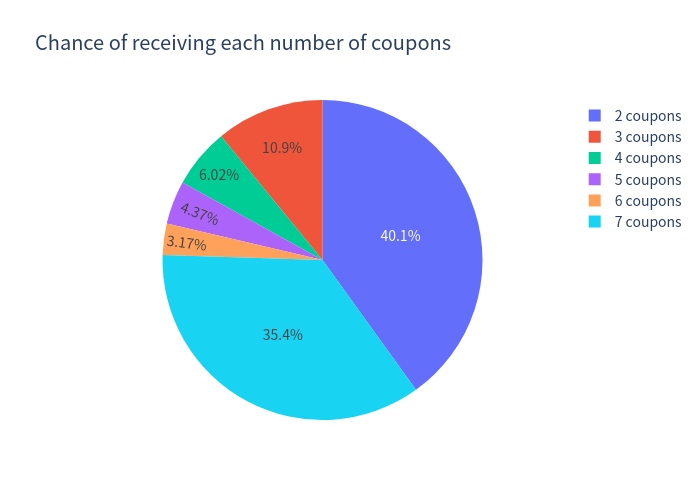
- Early call (issuer redemption) probability: 64.57% of paths (mostly at month 6); held to maturity: 35.44%.
- Barrier breach over the life of the note (continuous observation): 30.19% of paths.
- Maximum achievable annualized return is capped at 8.00% (the coupon rate).
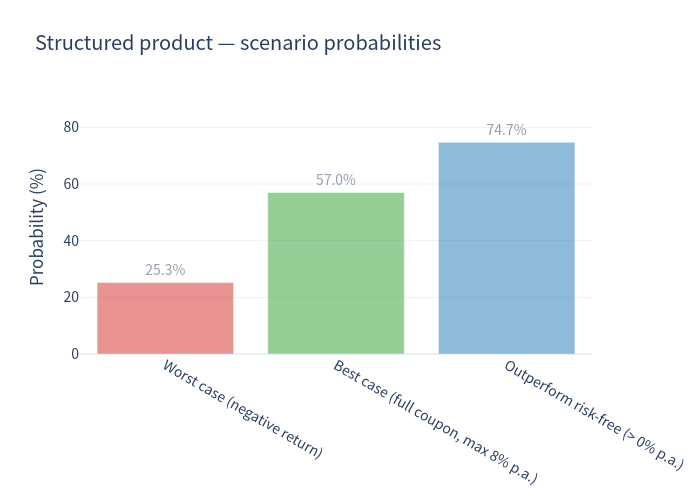
- Scenario probabilities: negative return 25.27% · full coupon at max 8% p.a. 57.03% · beat the risk-free rate (about 0%) 74.72%.
- The three underlyings currently yield about 5.19% (AXA), 3.48% (Helvetia Baloise) and 5.03% (Zurich) — an equal-weight basket yield of about 4.57%. The note holder does not receive these dividends; they are replaced by the fixed 8% coupon.
Charts
Simulation outcomes — product vs. underlying
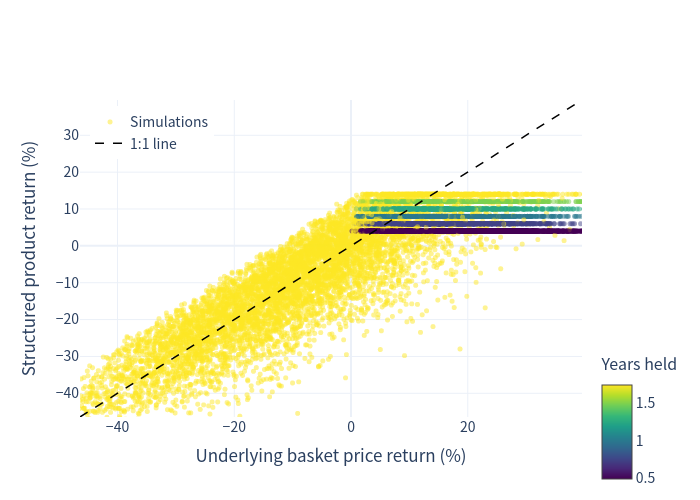
Each dot is one simulation: the structured product's return (y-axis) versus the underlying basket's price return (x-axis), coloured by holding period. The product return is capped — points flatten along a ceiling regardless of how far the basket rises — while the downside tracks the basket once the barrier is breached.
Annualized return distributions — underlying
Annualized return distributions — product
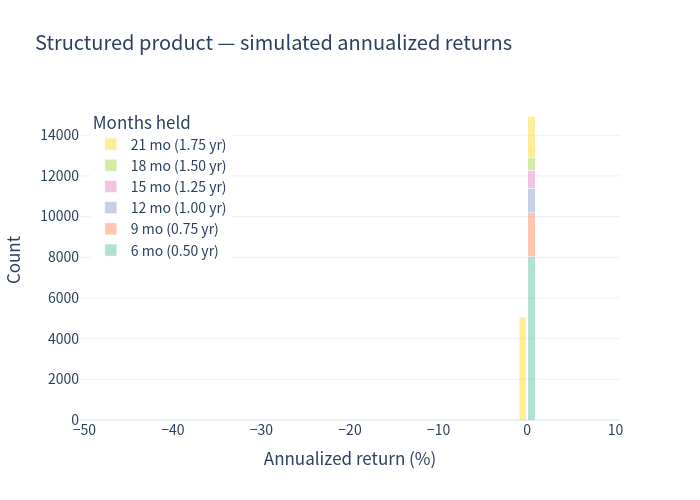
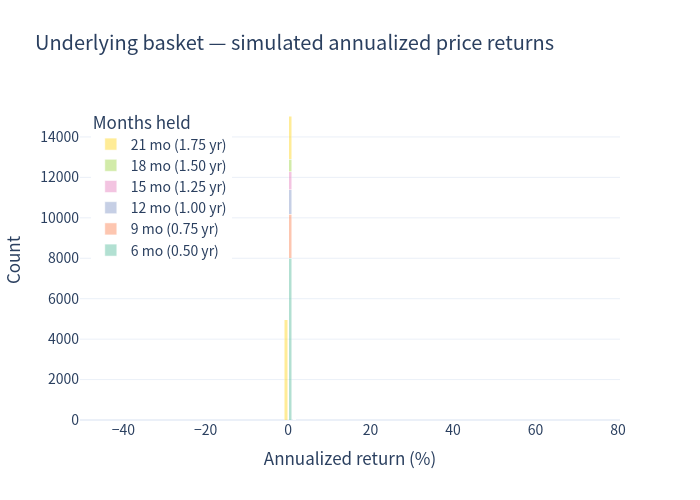
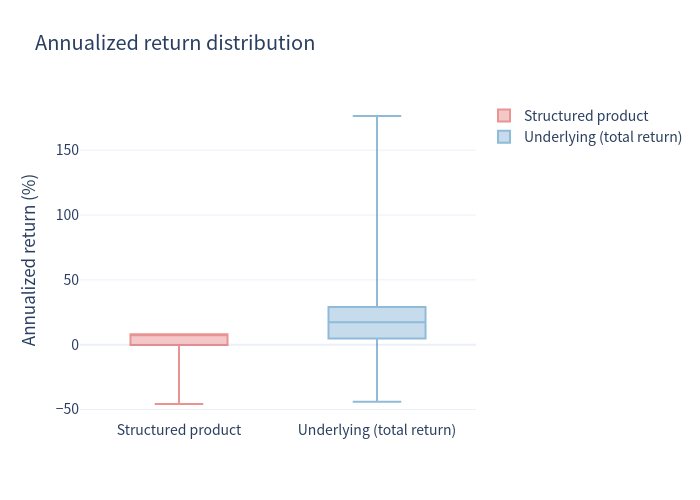
The underlying spreads from deep negative to very high positive outcomes (stacked by holding period). The product's distribution is far more compressed and hard-capped at +8% p.a., with a fat left tail extending to roughly -45%.
Scenario probabilities
Risk vs. return
Return distribution comparison
Holding-period outcomes — months held
Coupon outcomes
- Chance of being held 0.50 yr: 40.07% · 0.75 yr: 10.93% · 1.00 yr: 6.02% · 1.25 yr: 4.37% · 1.50 yr: 3.17% · 1.75 yr: 35.44%.
- Chance of receiving 7 coupons: 35.44%; 6: 3.17%; 5: 4.37%; 4: 6.02%; 3: 10.93%; 2: 40.07%.
Investment Commentary
Potential strengths
- High current income. An 8.00% p.a. coupon paid quarterly, unconditional while the note is alive, is attractive versus CHF cash rates of roughly 0%.
- Meaningful conditional buffer. The 69% barrier (a 31% decline allowance, measured on the weakest of three shares) means principal is returned in the majority of moderate-stress scenarios, including periods where the shares finish below their starting level but never breach 69%.
- Quanto CHF. Although AXA is a EUR stock, the payoff is currency-protected, so EUR/CHF moves do not affect redemption.
- Issuer/counterparty quality. Guaranteed by PostFinance Ltd (S&P AA).
Considerations and risks
- Worst-of payoff. The protection is only as good as the single weakest underlying; with three correlated insurance names the barrier-breach probability rises materially (about 30% of paths), and the loss when breached is the worst performer's decline (tail beyond -45%).
- Fully capped upside. All appreciation above par is forgone; the maximum annualised return equals the coupon (8%), so the risk/return profile is asymmetric — equity-like downside with bond-like upside.
- Issuer-call asymmetry. The issuer redeems early precisely in the strongest scenarios (about 65% of paths, usually after only 6 months), so the high coupon is often earned for a short period; the note stays outstanding mainly in the weak scenarios where you would prefer it to end.
- Expected total return near zero in this simulation. Coupon income is, on average, almost exactly offset by principal losses, so the note screens as a roughly break-even, high-variance proposition versus a much higher expected return for the underlying basket (though with similar volatility).