
11.40% p.a. Multi Barrier Reverse Convertible on Saint-Gobain, Heidelberg Materials & Holcim
Headline Simulation Results
| Metric (annualized) | Structured Product | Underlying basket (total return) |
|---|---|---|
| Expected annualized return | 7.13% | 20.40%* |
| Probability of negative return | 14.87% | 25.08% |
| 99% VaR (1-year, 1st percentile) | −27.49% | −29.19% |
| Median annualized return | 11.40% | 17.53% |
| Expected annualized volatility | 10.12% | 28.01% |
*Simulations completed to the product's actual (variable) holding period. The product returns its full coupon (≈11.40% p.a.) in the large majority of paths (see below), but the mean is pulled down by the loss tail. The underlying figure is inflated by the holding-period annualization (strong underlying moves trigger early calls with short horizons); measured on a fixed 21-month horizon the underlying's annualized total return is ≈9.50%.
How the Product Works (plain language)
This is a yield-enhancement note linked to the worst performer of three European building-materials stocks — Compagnie de Saint-Gobain (France), Heidelberg Materials (Germany) and Holcim (Switzerland). It pays a fixed 11.40% per year coupon (EUR 28.50 per EUR 1,000, quarterly) regardless of how the stocks perform.
- If the "worst-of" stocks never fall to 55% of their starting level during the life of the note (continuous monitoring), the investor gets 100% of capital back at maturity plus all coupons.
- If any stock touches its 55% barrier, downside protection is lost: at maturity the investor receives par only if the worst stock has recovered to at least its starting level; otherwise the investor is exposed to that worst stock's fall (capital loss), plus whatever coupons were already paid.
- Upside is capped at the coupon stream — the investor does not share in any stock gains above the starting level.
- The note is callable at the Issuer's discretion (not linked to a public trigger); if called, the investor receives par plus the coupon due on that date and the note ends. In this analysis the Issuer is assumed to call whenever the worst-of level is at or above its starting level on a scheduled observation date.
Product Snapshot
| Item | Detail |
|---|---|
| ISIN / SIX symbol | CH1607603748 / AIEITQ |
| Issuer / Guarantor | Leonteq Securities AG / Aargauische Kantonalbank (AA+) |
| Issue price / Denomination | 100.00% / EUR 1,000 |
| Settlement | EUR (Quanto — no FX exposure) |
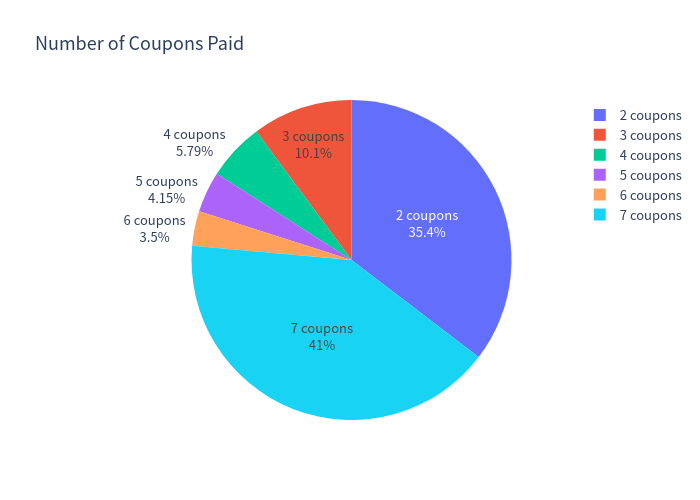
| Coupon | 11.40% p.a., quarterly (7 coupons to 17/08/2028) |
| Barrier | 55% of initial, continuous, worst-of |
| Early redemption | Callable by Issuer on 5 observation dates |
| Upside | Capped (no participation) |
| Final fixing / Redemption | 11/08/2028 / 17/08/2028 |
Return & Risk Profile
Because the note is callable, its life is variable. The expected holding period is ≈13.6 months, and 45.5% of paths end before 12 months (mostly called after 6 months when the stocks are up). Annualizing very short, strong paths can make annualized figures look extreme, so total return and holding period should be read together:
| Holding-period view | Structured Product | Underlying basket |
|---|---|---|
| Expected total return over realized holding | 6.00% | 8.59% |
| Expected holding period | ≈13.6 months (45.5% < 12m) | same horizon per path |
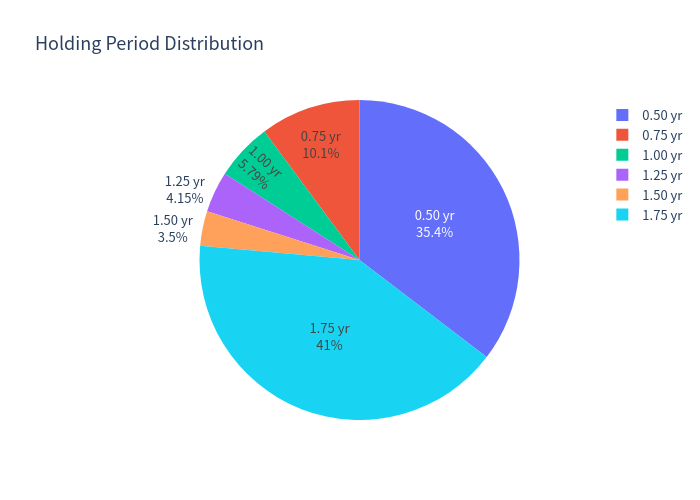
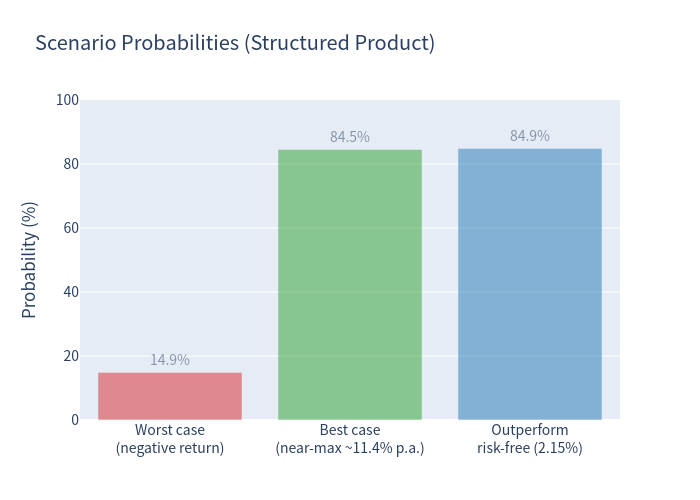
Outcome distribution: the note is called at month 6 in 35.4% of paths, and held all the way to maturity (month 21) in 41.0%. A continuous barrier breach occurs in ≈17.4% of paths; among the 41% that reach maturity, ≈37.7% suffer a capital loss (worst stock below its starting level at maturity). Overall the product delivers an annualized return at or near the 11.40% p.a. coupon run-rate in ≈84.5% of paths (early-called paths reach this through fewer but faster-accrued coupons; only paths held to maturity receive all 7 coupons).
Scenario Probabilities
| Scenario | Probability |
|---|---|
| Worst case (negative total return) | 14.87% |
| Best case (near-maximum ≈11.40% p.a. coupon outcome) | 84.54% |
| Outperforms the risk-free rate (2.15%) | 84.87% |
Charts
Simulated outcomes — product vs underlying
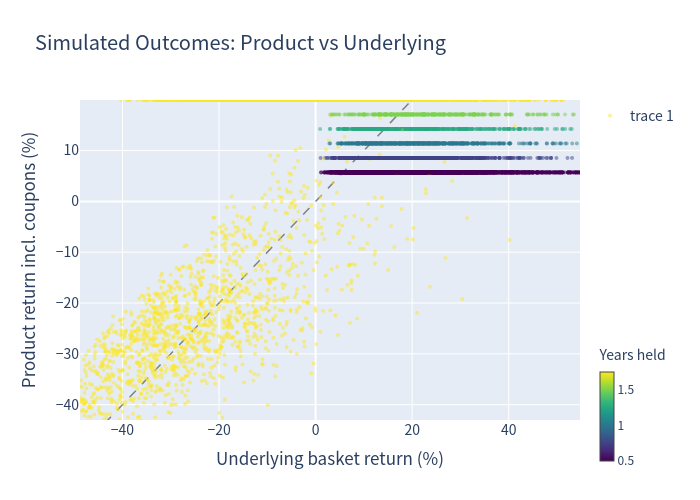
Each dot is one simulation. When the basket rises, the product is typically called and its return is capped near the coupon (flat band just above 0%), while deep basket declines push the product negative (below the 45° line only where the barrier is hit).
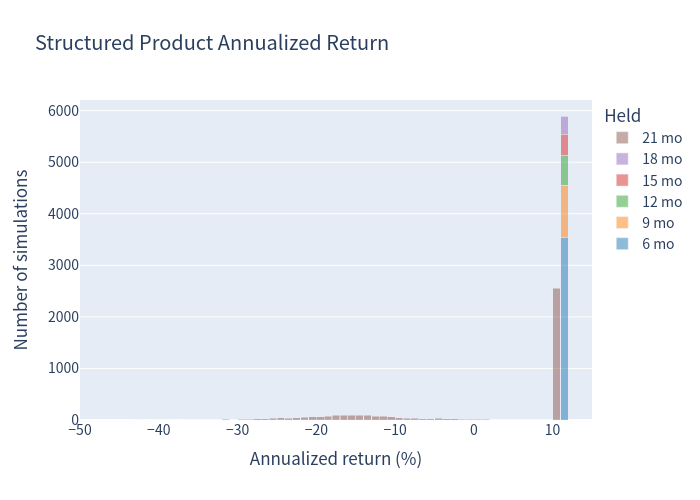
Structured product annualized return distribution
Strongly bimodal: a large mass at ≈11.40% (full coupon, called or protected) and a loss tail down to ≈−43% for barrier-breach scenarios.
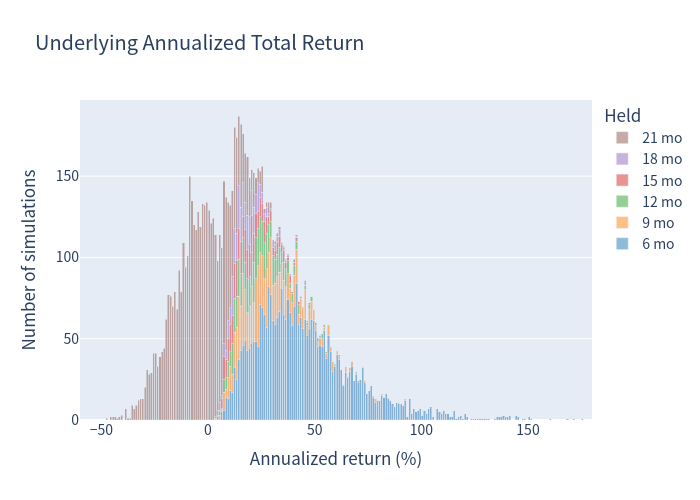
Underlying basket annualized total return distribution
A wide, roughly symmetric distribution with a much fatter right tail (short-horizon annualization of strong early-call paths) and meaningful left-tail risk.
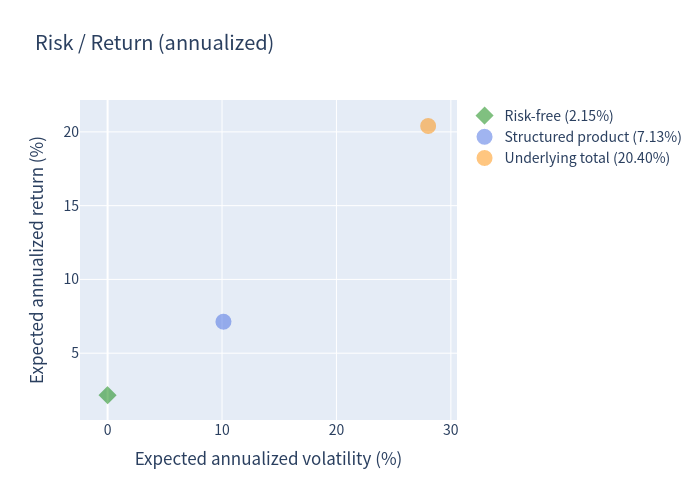
Risk / return comparison
The product offers a lower expected annualized return than the raw basket but with roughly one-third of the volatility, sitting well above the risk-free rate.
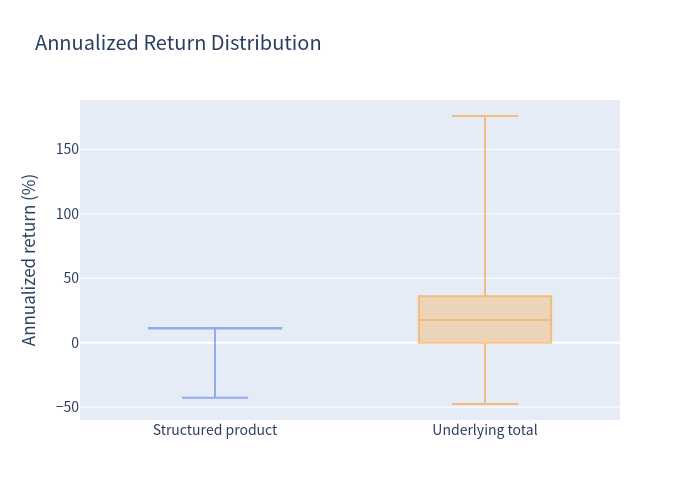
Annualized return box plot
The product has a high, tightly-clustered median (≈11.40%) with a modest loss tail, versus the basket's wider interquartile range and lower median.
Holding period and coupon-count distribution
Scenario probability bar chart
Investment Commentary
Potential merits
- High headline coupon (11.40% p.a.) with a wide 55% barrier — protection only breaks if a stock falls ~45% from its starting level, and it must actually trade there (continuous).
- Coupons are paid regardless of underlying performance, so a meaningful coupon is collected even in flat or mildly negative markets.
- Shorter-than-maturity average life in up-markets (called early, capital returned), and lower realized volatility / loss frequency than holding the basket directly (14.9% vs 25.1% probability of loss).
- Quanto EUR removes currency risk on the Swiss (Holcim) exposure.
Risks / drawbacks
- Worst-of exposure to three correlated, cyclical construction-materials names — the note is only as strong as the weakest stock.
- Capped upside: strong rallies are truncated by the Issuer's call, so the investor forgoes equity participation above the starting levels.
- Barrier loss: if the 55% barrier is breached and the worst stock does not recover to its starting level, the investor takes that stock's downside (capital loss), with a 99% 1-year VaR of ≈−27.5% and a worst-case annualized outcome near −43% in the simulation.
- Issuer credit risk (Leonteq; guaranteed by Aargauische Kantonalbank). Early redemption is at the Issuer's discretion.
This is a quantitative analysis for information purposes only and does not constitute investment advice or a suitability assessment.