
info@tokenengine.ai
Morgan Stanley Finance LLC — Callable Jump Notes due October 3, 2031
Headline Simulation Results
The notes are fully principal-protected — in 10,000 simulations not one produced a loss of principal, because the terms floor every outcome at the $1,000 stated principal amount. The trade-off is a capped upside: the issuer's "jump" redemption payment accretes at only about 14% per year and the notes are callable monthly from year 1, so the annualized return is compressed into a band of roughly 0% to ~15% in virtually all simulated scenarios, no matter how far the underliers rally.
How the Notes Work (plain language)
- The notes are linked to the worst performer of three indices — Nasdaq-100 Technology Sector (NDXT), Russell 2000 (RTY) and S&P 500 (SPX). The worst index governs the outcome; holding three indices provides no diversification benefit.
- If held to maturity: you receive the $1,000 principal back plus 125% of the worst index's gain, but only if every index finished above its starting level. If any index is flat or down, you receive exactly $1,000.
- Issuer call: from month 12 onward Morgan Stanley may redeem the notes on any monthly date. If it does, you receive an accreted amount that grows ~14%/yr — $1,140 at month 12 rising to $1,688 at month 59 — and the note terminates. The issuer calls whenever its valuation model finds redeeming cheaper than continuing, which in practice happens after strong underlier rallies; the call therefore truncates the note's upside.
- There is no coupon and no barrier. The cost of principal protection is forgone income plus the capped upside. All payments are subject to the issuer's credit risk.
Structured Product vs. Underlying Benchmark
| Metric | Structured Product | Underlying basket (total return) |
|---|---|---|
| Expected annualized return | 6.80% | 13.99% |
| Expected annualized volatility | 5.67% | 15.47% |
| Probability of loss | 0.00% | 15.30% |
| 99% confidence VaR (1-year) | 0.00% | -12.52% |
The structured note gives up a substantial part of the equity upside in exchange for removing downside: its expected return is about half the basket's, but its volatility is roughly one-third and its worst case is a full return of principal rather than a loss.
Simulation Charts
Chart 1 — Simulation Outcomes vs. Underlying
Each point is one simulation; the colour shows how many years the note was held, and the dashed line is the 1:1 line. Points sit above the line in negative-return territory (principal protection) and below it when underliers rally hard (the issuer calls and caps the upside).
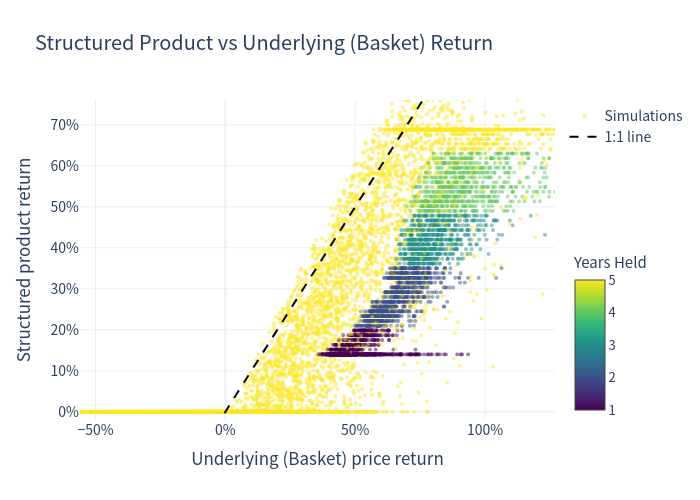
Chart 2 — Underlying Annualized Return Distribution
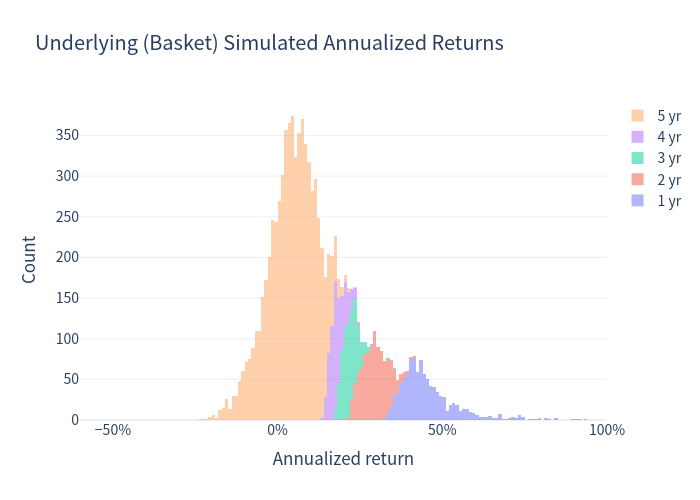
Chart 3 — Structured Product Annualized Return Distribution
The product's distribution is squeezed into a narrow 0%–15% band, with a distinct spike at 0% (the fully-protected "par" outcome) and stacking by holding period.
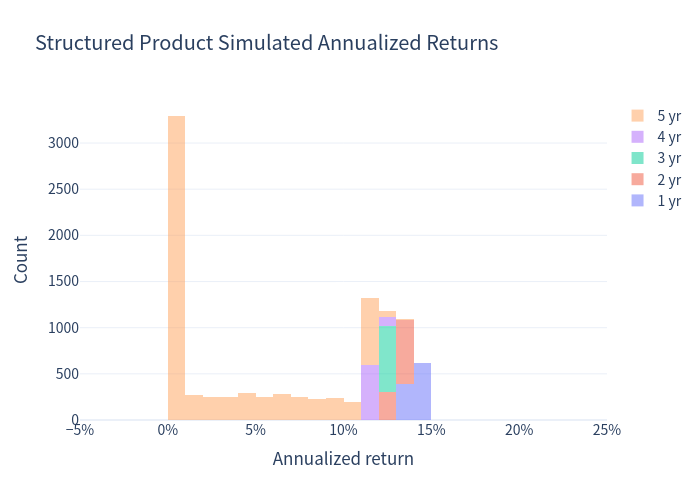
Chart 4 — Scenario Probabilities
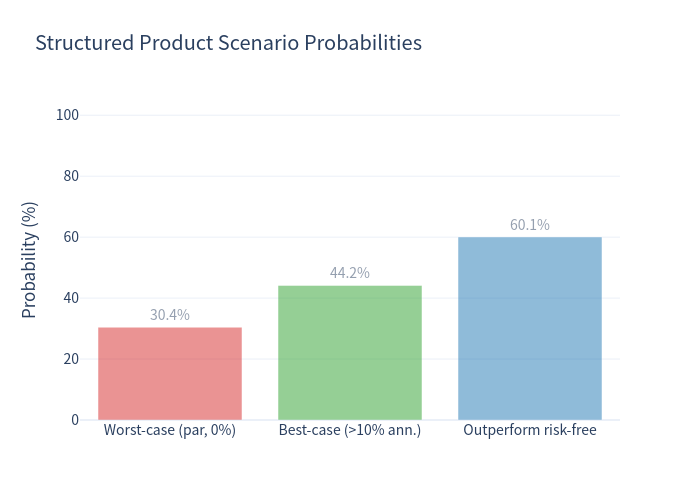
- Worst case (return of principal, 0%): 30.45% of simulations
- Best case (annualized return above 10%): 44.17% of simulations
- Outperforming the risk-free rate: 60.05% of simulations
Chart 5 — Risk / Return Profile
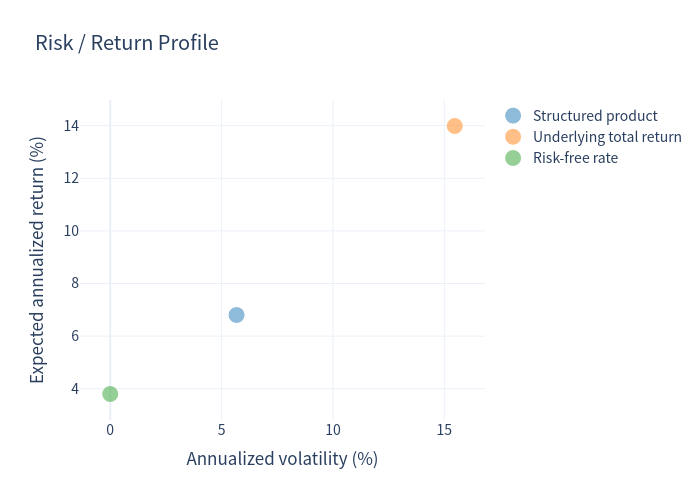
Chart 6 — Distribution of Annualized Returns (Box Plot)
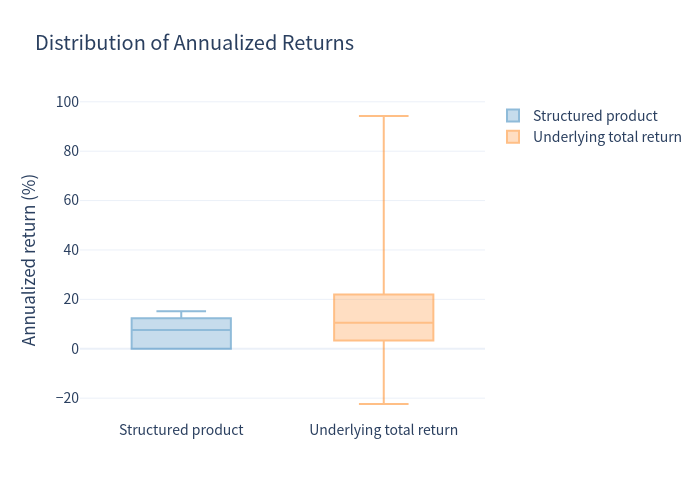
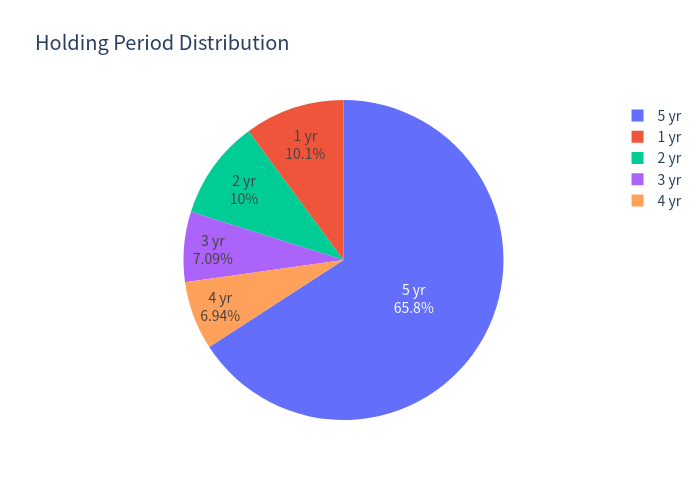
Chart 7 — Holding-Period Distribution
Roughly 40% of simulations end early via the issuer call; the remainder run the full five years.
Investment Commentary
Points in favour
- Principal protection with no barrier. The downside is a full return of the $1,000 principal in every simulated path; the risk of an outright loss arises only from issuer credit risk. This makes the payoff profile materially more defensive than a direct index investment.
- Leveraged participation (conditional). When all three indices rise, the investor earns 125% of the worst index's gain. The 25% leverage helps when the indices rise together, but because the payoff tracks the weakest index, 125% x worst can be less than the basket's average return whenever the indices diverge — worst-of reduces, rather than adds to, the diversification benefit.
- High "carry" if called. The accreted redemption amount (≈14% p.a.) is well above cash rates; whenever the issuer exits, the realised return is an attractive annualised figure (≈11%–14%).
- Favourable risk-adjusted profile vs. the underlying. Volatility is ~5.7% versus ~15.5% for the basket, and the strategy produces positive returns far more reliably than the underlying.
Points to weigh
- Upside is effectively capped. Because the issuer calls after strong rallies, the annualized return rarely exceeds ~15%, even when the underliers more than double; the investor forgoes most of the equity upside.
- No income while the note is outstanding, and the opportunity cost of tying up capital for a multi-year horizon is real.
- Worst-performing index concentration. Linking to three correlated US equity indices adds no diversification; the single weakest index determines the payoff.
- Returns depend heavily on the issuer's call behaviour, which is model-driven rather than linked to a transparent underlier trigger.